

Grand Theft Auto VI launches this Thursday, November 19, 2026. Millions of players are about to discover a 3D world so detailed it looks like filmed video. The same family of technologies now makes it possible to replicate a store faithfully, so you can walk through it, test it and get it approved before building anything.
- GTA 6 showcases thirty years of progress in real-time 3D, from the top-down view of 1997 to photorealistic open worlds.
- A game invents a believable world; a 3D showroom replicates a real store at its exact dimensions.
- Built from real plans and products, the virtual store lets you test layouts, POS and signage before producing them.
GTA 6, a showcase of thirty years of progress in 3D
GTA 6 is as eagerly awaited for its story as for its graphic realism. Rockstar Games set its release date for Thursday, November 19, 2026, on PlayStation 5 and Xbox Series, and its latest trailer passed 475 million views in 24 hours according to the publisher (Video Games Chronicle). In thirty years, the series has gone from a city seen from above to a near-photorealistic open world.
From video games to stores: the same shift in perspective
Retail has followed the same path. For years, a shelf was prepared on a planogram: a flat view, like the 1997 city, that everyone had to picture in volume. Yet shoppers never see their store from above. They discover it at eye level, walking down the aisles.
Real-time 3D now makes that point of view available before anything is installed. On the Retail VR platform, you don't step into an invented city but into your own store, replicated down to the centimeter: you move around freely, just like in a game, but every shelf, every fixture and every product is exactly where it belongs. The store still has to be both accurate and believable.
How to replicate a store in 3D
A virtual store is built from real data, not artistic interpretation: plans, fixtures, products and planograms. That is the fundamental difference with a game set.
- The building and fixtures. With Store Builder, the store is built from its plans (DXF and DWG formats supported), then fitted with its real fixtures.
- The products. Each SKU is modeled in 3D automatically from a photo and its dimensions.
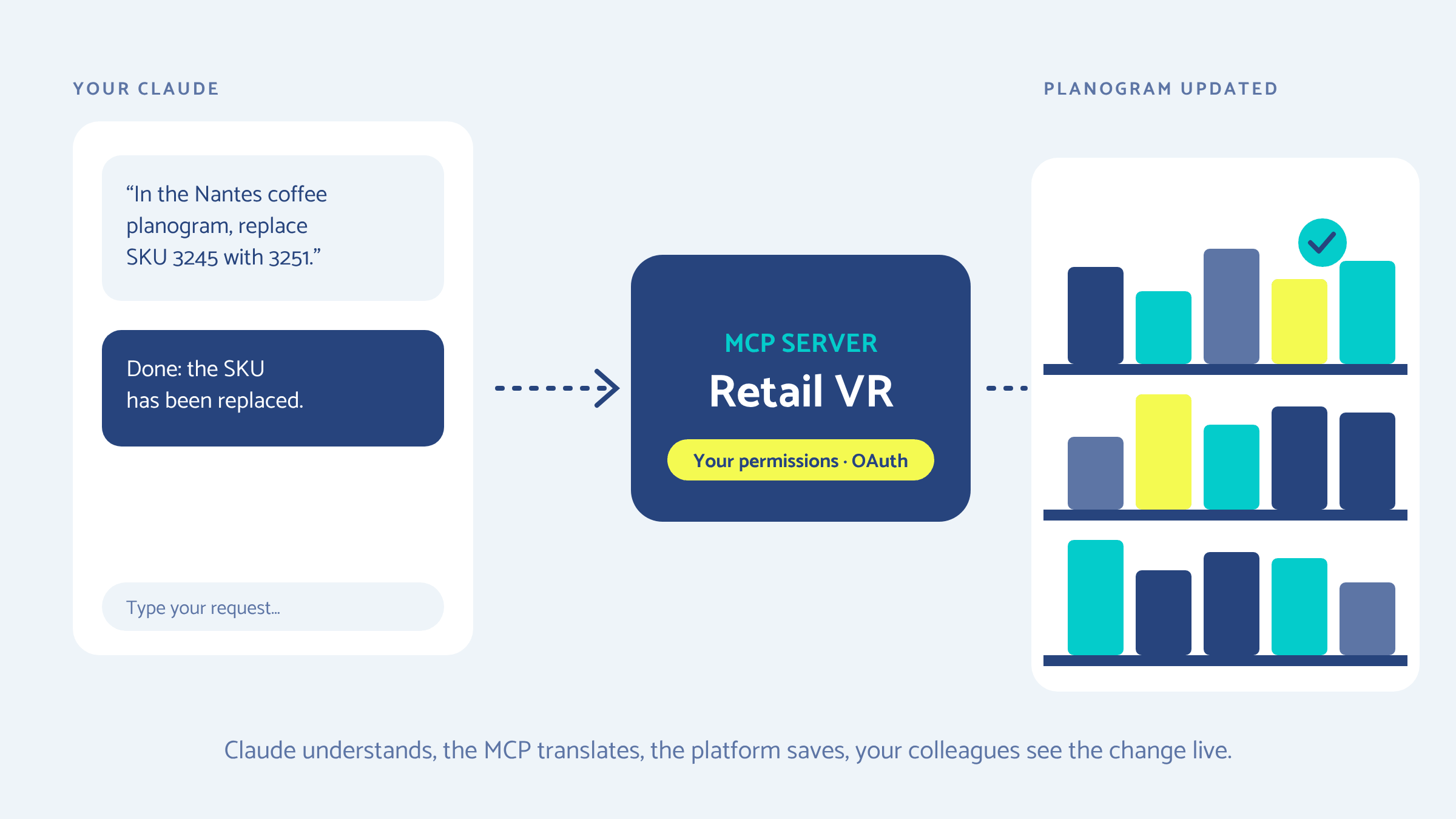
- The shelves. 3D planograms put every product in its place; files from existing tools (PSA, PLN) import directly.
- Existing locations. A store that is already open can also be scanned as a digital twin with our partner Matterport, capturing the space with its measurements.

What makes a virtual store believable
A 3D showroom doesn't need to compete with a game that took years to develop, but it does need its essential ingredients. Used to realistic open worlds, users compare: if the set looks like a mock-up, they disengage; if they recognize their store, they buy in.

- Freedom of movement: instead of looking at an image, you move through the store at your own pace. The showroom opens from a simple link on a standard computer, and can also be explored with a virtual reality headset for full immersion.
- Scale: an aisle should feel as wide as a real aisle, a shelf as tall as a real shelf.
- Light and materials: floors, refrigerated cases, displays and signage look distinct, just as they do in store.
- Full, readable shelves: an empty shelf feels fake. Modeled from photos, products remain identifiable, brand and size included.

Realism isn't just about looks. In a 3D shopper study, it is one of the conditions for reliable results: the more a shelf is perceived as a real shelf, the closer the panelist's behavior is to how they shop in store.
Video games and 3D showrooms: same technology, opposite goals
A game aims to amaze; a 3D showroom aims to get decisions right. That changes everything about how they are built.
The world of GTA 6 doesn't exist: the game is set in a fictional version of Florida, the state of Leonida, and its main city, Vice City, is directly inspired by Miami (Dexerto). A game can move a street or shrink a city for the player's enjoyment. A virtual store, on the other hand, must be an exact copy of the real one, because decisions are made from it.
| Criterion | Video game world | Retail VR 3D showroom |
|---|---|---|
| Purpose | Entertain, tell a story | Test, present, get a decision approved |
| Relationship to reality | Inspired by reality, freely adapted | A faithful replica of the real store |
| Source of dimensions | Chosen for visual effect | Store plans, fixtures and products at their real dimensions |
| Users | Gamers | Brand and retailer teams, buyers, shopper panels |
The benefits of a store replicated in 3D
A virtual store that is true to life means you can try everything before producing anything. According to Retail VR, a project designed on the platform is 5 times faster to roll out than with traditional methods, and decision-making is 10 times faster.
What 3D doesn't replace
However realistic it is, 3D remains a preparation tool: it reduces errors, but it doesn't replace the field. You can't touch a material or measure sales in it, and its value depends on the quality of the data: wrong dimensions make a wrong store, however good it looks.
To go further, read the advantages of a virtual showroom, seasonal peaks tested in 3D, holiday window displays in luxury, our definition of virtual reality and immersive technologies.
Frequently asked questions
What do GTA 6 and a 3D showroom have in common?
Both run on real-time 3D: a modeled world you can move through freely. But a game like GTA 6 is built to entertain, while a 3D showroom is built to prepare and approve decisions about a real store.
Can a store really be replicated in 3D down to the centimeter?
Yes, as long as you start from accurate data: store plans and the dimensions of fixtures and products. On the Retail VR platform, the store is built from these measurements, products are modeled at their real dimensions, and planograms are imported from existing tools.
Do you need a gaming PC or a VR headset?
No. A Retail VR showroom opens from a simple link on a standard computer. A virtual reality headset remains an option for full immersion, for example when presenting to a buyer.
Next step
The easiest way to judge how realistic a 3D store can be is to walk through one. We'll show you a showroom built on one of your aisles or concepts.
Want to see your store replicated in 3D, down to the centimeter?
Request a demo →