

Introduction
76% of purchasing decisions are made in-store, and yes, merchandising plays a central role in in-store sales performance. Poorly executed, it can dampen customer engagement and significantly reduce revenues. Fortunately, thanks to 3D merchandising tools, it's now possible to anticipate and avoid these mistakes. Here's a look at 10 common merchandising mistakes that 3D can help you avoid.
1. Poor distribution of sales space
Poor in-store space management can lead to overcrowded or under-utilized areas, reducing shopping comfort and point-of-sale efficiency. By optimizing space, some retailers are able to increase sales by up to 20%.
3D merchandising can therefore be used to simulate and optimize the distribution of spaces according to customer flows, by visualizing high-traffic areas and identifying cold zones. 3D merchandising makes it possible to carry out reliable, low-cost studies before implementing a new concept. Test for better deployment.
2. Inconsistent layout
An incoherent layout, where products are not arranged logically, can confuse customers. Thanks to 3D tools, retailers can visualize the overall layout of the store in real time and ensure that visual harmony is respected, both in terms of product presentation and customer paths.
Adding data to the planogram or, more generally, to the sales area as a whole, also helps to visualize and rationalize the layout, and to make the most of the surface area per m².
3. Poor promotion of flagship products
Products with high sales potential need to be placed at the top of the shelves or in strategic locations. However, they are often relegated to the background, diminishing their visibility. 3D merchandising solutions make it possible to test several placement scenarios to maximize the visual impact of these products before moving on to physical placement.
The representation of numerical indicators (e.g. sales per product), simplified by color codes, makes it possible to work on assortments to optimize them.

4. Failure to take the customer journey into account
The customer journey, i.e. the path a customer takes through a store, must be fluid and intuitive. A poorly organized path can create frustration and discourage purchases. Using 3D, it's possible to simulate different paths to see which is most conducive to customer engagement and product discovery.
5. Ignore customer preferences
A common mistake is to organize merchandising without taking into account customer expectations and preferences. With 3D merchandising, it's possible to use customer data to test different configurations and adapt to their expectations. This level of personalization is essential to deliver an optimized shopping experience.
6. Poor shelf stock management
Poorly stocked or, on the contrary, overstocked shelves are detrimental to sales efficiency. Customers who can't find the product they're looking for, or who are overwhelmed by too many items, risk leaving the store without buying. Thanks to 3D tools, it is possible to simulate stock management, forecast replenishments according to shelf configuration, and visualize shelf destruction in real time.
7. Underestimating the importance of lighting
Good in-store lighting can significantly boost sales, particularly by highlighting certain products and creating an atmosphere conducive to purchasing. However, this component is often overlooked. With 3D merchandising, you can test different lighting scenarios and see which one offers the best visual rendering to maximize product appeal. In fact, it's possible to simulate the positioning of luminaires, the addition of natural light through windows, or a night-time situation, to get as close as possible to the reality of the point of sale.
8. Failure to adapt merchandising to the seasons
Merchandising shouldn't be static; it should evolve with the seasons, promotions and trends. Failure to adapt your layout to these changes can mean missing out on sales opportunities. Thanks to 3D simulation tools, it's easy to plan seasonal changes and test new layouts without disrupting the store.
If there is any doubt about the future location, shopper studies can be carried out to validate a direction at a lower cost.
9. Lack of pre-implementation testing
Merchandising changes are often costly and time-consuming, especially if they have to be readjusted after installation. With 3D merchandising, configurations can be tested and adjusted upstream, at no extra cost and with no impact on the point of sale. This guarantees effective implementation right from the outset.
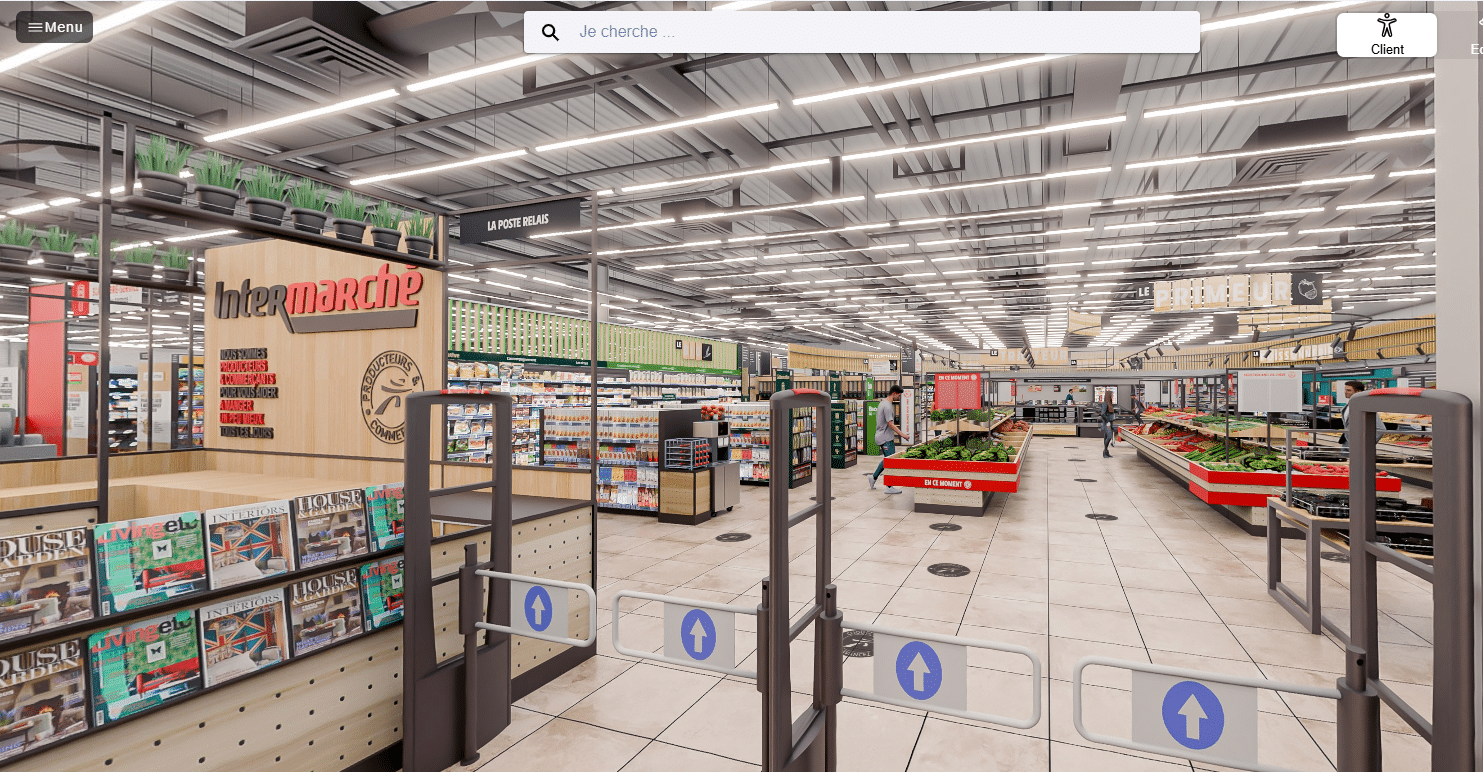
These tests can be carried out for micro-installations, but also to simulate product or signage highlighting systems. Being able to test signage before installation is a significant economic lever. Find out how Intermarché improves decision-making processes and saves money with 3D merchandising.

10. Neglecting environmental impact
Environmental impact is a growing concern for retailers and consumers alike. 3D's ability to optimize and simulate design projects will help reduce prototypes, mock-ups and physical tests of all kinds.
Poorly thought-out merchandising can also lead to wasted materials and frequent, costly modifications. 3D merchandising can reduce CO2 emissions linked to testing and design by up to 80%. By optimizing the use of resources and enabling more precise planning, 3D merchandising helps to reduce the ecological footprint of layout projects.
Conclusion
By avoiding these common mistakes with 3D layout and simulation tools, retailers can not only improve the customer experience, but also increase sales and reduce costs. 3D merchandising offers a new dimension of optimization, combining technological innovation and commercial efficiency.
If you'd like to find out how 3D merchandising can help you avoid these mistakes and optimize your points of sale, request a free demo today!