3D Merchandising

Retail VR vs. NielsenIQ Spaceman: Which merchandising software should you choose?

Written by
Erwan KROTOFF
26/3/2026
4 minutes

The retail market is evolving at breakneck speed. To remain competitive, brands and retailers must design, test, and roll out visual concepts in record time.

When it comes to equipping Category Management and Trade Marketing teams, two philosophies clash: historical analytical modeling and experiential innovation. Here is an objective comparison to help identify the merchandising software that best fits your brand strategy.

‍

‍

‍

‍

Spaceman: The Power of Analytical Optimization

Spaceman is a well-known software suite designed primarily for technical space management. Its philosophy is based on a rigorous analysis of historical sales data.

  • Strengths: A proven ability to analyze planograms based on financial data. Intelligent placement algorithms help optimize space allocations, generating revenue increases ranging from 10 to 20 percent, according to some studies.
  • Limitations: Complex interface requiring extensive training. The traditional architecture requires significant hardware power, and sharing planograms with field teams often relies on manual processes or third-party tools.

‍

‍

Retail VR: A Platform to Support Your Strategy

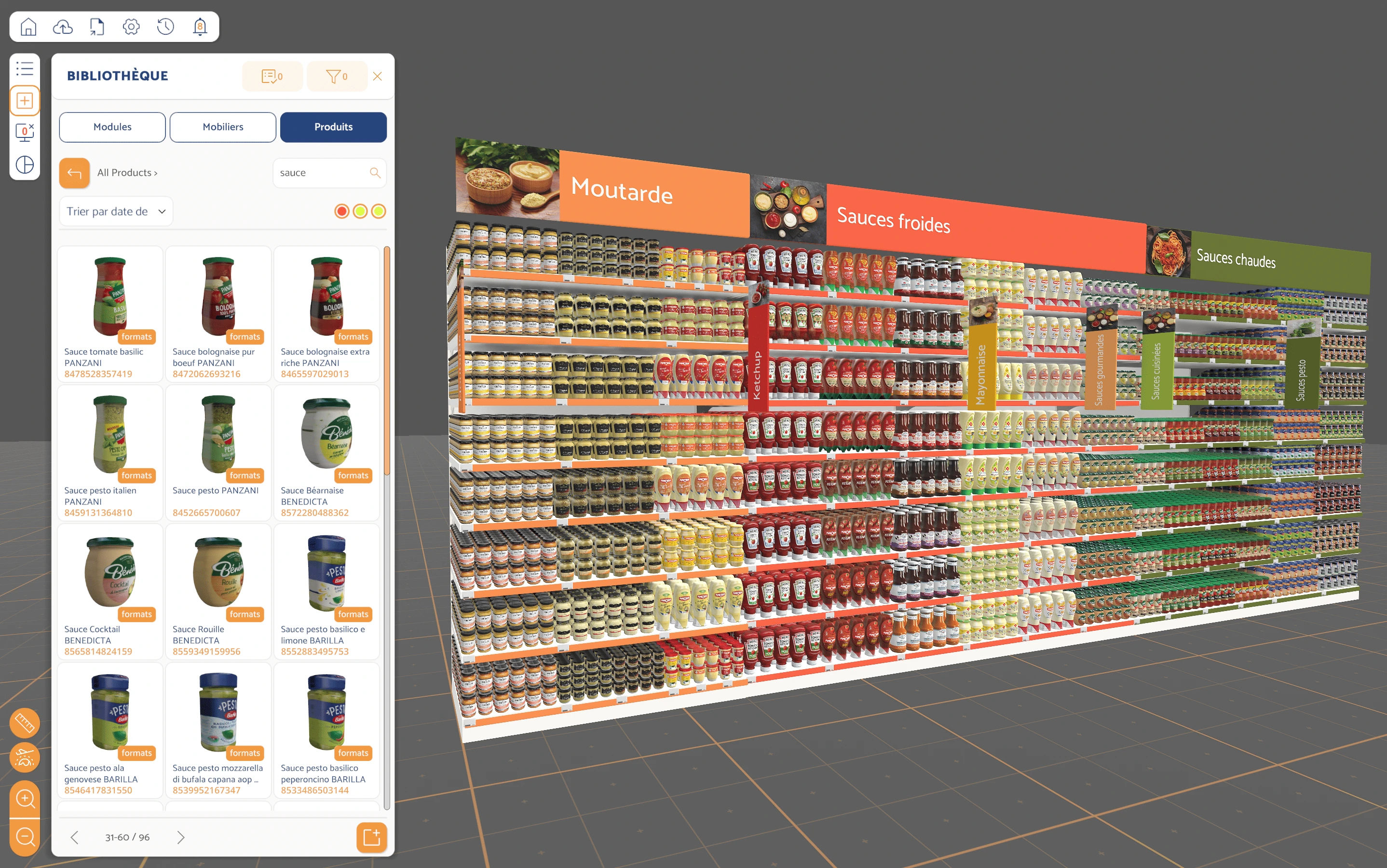
Unlike supply-chain-focused systems, Retail VR is a merchandising solution SaaS solution designed for visual agility. It enables you to transform your decision-making processes through a data-driven and collaborative architecture.

‍

1. AI Innovation and Speed of Execution

Using patented technology, the platform automatically converts your 2D packaging designs into digital models from simple photos. This automation speeds up your decision-making by a factor of 10 and allows you to roll out your plans 5 times faster.

‍

2. Shopper Studies: The Haribo Case Study

In partnership with Enov, Retail VR enables you to conduct large-scale qualitative and quantitative research. You can immerse a panel of consumers in a digital twin of your store to test your concepts before any physical production takes place, as demonstrated by the studies conducted for Haribo.

‍

‍

3. Field Implementation: The Digital Shopper Center

Recommendations are distributed instantly via the cloud. For companies such as Nestlé Café, implementing a “Digital Shopper Center” makes it possible to perfectly align headquarters’ strategy with execution at the point of sale.

  • Agile Validation: Sales teams use augmented reality in stores to validate concepts with department managers.
  • Result: This level of precision in execution leads to an average 13% increase in sales.

‍

‍

💡

Did you know that?

Automating merchandising drastically reduces time to market. By adopting a connected merchandising tool, you free your teams from repetitive tasks so they can focus on strategy.

‍

Comparison Chart: Retail VR vs. NielsenIQ Spaceman

Key Features Retail VR NielsenIQ Spaceman
Design SaaS (Cloud) Local Installation
Audience Experience / Strategy Operations / Supply Chain
AI & Automation Automatic Generation Manual / Database-driven
Mystery Shopper Tests Integrated natives Not available
Collaboration Instant Sharing (URL/QR) Manual Distribution (PDF)
Training Fast (a few days) System Requirements

‍

‍

‍

‍

Verdict: Analytical or experiential?

‍

  • Choose NielsenIQ Spaceman if your top priority is complex supply chain engineering and replenishment, with dedicated resources for technical analysis.

‍

  • Choose Retail VR if your goal is to reduce your time-to-market, improve collaboration among your teams, and win over your partners with photorealistic simulations.

‍

Need to change your strategy?

‍

Request a demo

‍

Our Virtual Showroom solution enables your customers to browse through a digitalized physical space that mirrors the visual merchandising of your stores.

Our Virtual Store solution enables your customers to immerse themselves in a more emotionally powerful shopping experience that generates higher conversion rates.

Our Instore Activation solution enables you to meet customer requirements while simplifying the work of your sales force.

You may also be interested in these articles you might also like

Wine Fair Merchandising: Should Headquarters Plan the Aisle Down to the SKU?
Actualité
Wine Fair Merchandising: Should Headquarters Plan the Aisle Down to the SKU?
Every fall, the French 'Foire aux Vins' wine fairs held by supermarkets transform the wine aisle in just a few days. Between local SKUs, fast-shrinking stock and in-store team expertise, how far should headquarters go in guiding shelf placement? We take stock, look at the arrival of alcohol-free wines, and explore what AI and 3D simulation can bring to the table.
Erwan Krotoff
October 6, 2026
•
2 minutes
Read the article
Pet Store Merchandising: How to Optimize Pet Food, Pet Care and Accessories Aisles
3D Merchandising
Pet Store Merchandising: How to Optimize Pet Food, Pet Care and Accessories Aisles
Pet store merchandising in 2026: how can you optimize pet food, pet care and accessories aisles with 3D simulation? A complete guide for Maxi Zoo, Animalis, Tom&Co and pet food manufacturers.
Erwan Krotoff
September 28, 2026
•
4 minutes
Read the article
Retail VR & generative AI: save 80% of the time spent on your planograms
3D Merchandising
Retail VR & generative AI: save 80% of the time spent on your planograms
AI and large language models are transforming the merchandising chain, from planograms to POS materials. Here is how to automate your store layouts, personalize at scale, and free your teams from repetitive tasks.
Erwan Krotoff
September 24, 2026
•
3 minutes
Read the article

By clicking "Accept All", you agree to have cookies stored on your device to improve site navigation, analyze site usage, and assist in our marketing efforts. See our Privacy Policy for more information.