

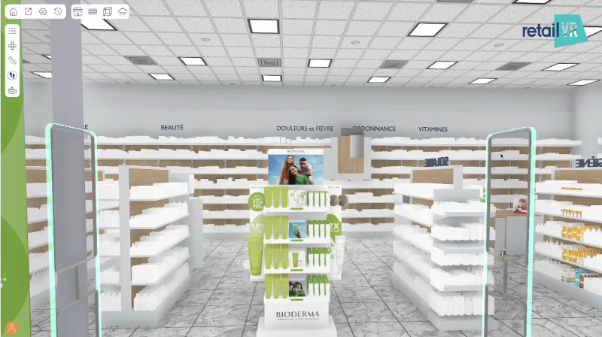
With more than €6 billion in sales in 2025 and annual growth of +5%, the French parapharmacy market (health and beauty products sold outside prescriptions) is one of the most dynamic segments of French retail. Independent pharmacies, pharmacy groups such as Pharmabest or Giphar, and parapharmacy aisles in mass retail are all competing harder to win over shoppers who are increasingly demanding about product quality, ingredient transparency and a seamless shopping journey. In this context, parapharmacy aisle layout has become a strategic issue in its own right. And 3D — immersive planograms, shopper journey simulation, field audits using image recognition — is profoundly transforming merchandising practices in this sector.
The parapharmacy market in France: a sector in full transformation
Key figures for 2025
| Market indicator | 2025 figure |
|---|---|
| Parapharmacy sales in France | > €6 billion |
| Average annual growth (since 2020) | +5% per year |
| Pharmacies' share of sales | ~72–80% by value |
| Average basket in pharmacies | €42.02 (Sept. 2025) |
| Dietary supplements growth | +8% to +10% per year |
| Skincare market | €2.5 billion |
| 2030 market projection (all channels) | ~€10 billion |
| Pharmacy channel growth (Aug. 2023 – Aug. 2025) | +13% vs. +3.4% for mass retail |
Why merchandising is becoming decisive in this sector
Several trends are converging to make parapharmacy aisle layout a top-tier commercial lever:
- The rise of premium brands: Bioderma, La Roche-Posay, Nuxe, Avène, CeraVe — these high-value dermocosmetic brands account for a growing share of pharmacy sales. Their shelf visibility is directly correlated with their sales performance, in a space that is often tight (50 to 250 m² of parapharmacy space in an average pharmacy).
- Competition between channels: the pharmacy channel grew by +13% between August 2023 and August 2025, compared with just +3.4% for grocery mass retail. Pharmacists are investing heavily in optimizing their parapharmacy space to defend this lead against Leclerc, Carrefour and e-commerce pure players.
- The boom in dietary supplements: +8% to +10% annual growth since 2023, for €1.2 billion. A complex category to merchandise (many SKUs, strong seasonality, need for product education) that benefits greatly from a structured 3D planogram.
- The diversity of pharmacy formats: unlike mass retail, every pharmacy has its own fixture dimensions, its own space configuration and its own regulatory constraints. This diversity makes planogram standardization complex — and the adaptability of 3D essential.
💡 Did you know?
In 2025, pharmacies account for around 72% to 80% of parapharmacy sales in France. Pharmabest, the leading pharmacy group, posted €1.5 billion in sales in 2025, with a loyalty program of 1.4 million members. These figures illustrate the growing professionalization of merchandising in the pharmacy channel.
What makes pharmacy merchandising different from mass retail
Merchandising in pharmacies follows different rules from mass retail. Understanding these specifics is essential to designing an effective planogram for this channel.
| Criterion | Pharmacy | Mass retail (hypermarkets / specialist stores) |
|---|---|---|
| Sales area | Small (50–250 m² of parapharmacy) | Large (dedicated aisle of 100–400 m²) |
| Fixture formats | Highly varied from one pharmacy to another | Standardized by retail banner |
| Role of advice | Central — pharmacist as prescriber | Secondary — self-service |
| Seasonality | Strong (SPF, flu, allergies) | Strong but different (promotions) |
| Range turnover | Slow (loyalty to health brands) | Faster (beauty innovation) |
| Merchandising challenge | Visibility + product education | Visibility + traffic / promotion |
| Regulatory constraints | High (pharmacy monopoly) | Limited for over-the-counter products |
The pharmacist's key role in the purchase decision
In a pharmacy, the pharmacist acts as a prescriber in a way that a mass-retail shelf never can. A well-placed product in the parapharmacy aisle also benefits from a verbal recommendation by the staff. That is why pharmacy merchandising must both optimize product visibility (for self-directed shoppers) and make advice easier (for staff behind the counter). A 3D planogram lets you simulate both dimensions at once, testing visibility from the aisle entrance and SKU legibility from the counter.
The challenge of diverse pharmacy formats
An OTC laboratory rolling out its placement recommendations across a network of 500 pharmacies always runs into the same reality: no two pharmacies have the same fixture dimensions. A planogram designed for a 1.80 m gondola with 4 shelves cannot be applied directly to a 1.20 m gondola with 3 shelves without being rebuilt by hand.
Retail VR's 3D planogram platform solves this problem structurally: fixture dimensions are configurable, and the planogram is automatically recalculated for each point of sale's format. A single aisle concept can thus be adapted into multiple format-specific variants in a few minutes — with no manual re-entry.
How 3D is transforming pharmacy merchandising
1. From 2D planograms to immersive 3D planograms
The traditional 2D planogram — a flat, front-on diagram — is poorly suited to the specifics of pharmacies. Pharmacy owners, who are not trained in merchandising, struggle to picture the result from an abstract diagram. Pharmaceutical sales reps find it hard to explain the recommended layout during their visits. The result: up to 40% of pharmacy shelf layouts do not match the laboratories' recommendations.
Retail VR's 3D planogram radically changes this equation. The pharmacist sees exactly what their aisle will look like after implementation, from the store entrance. The pharmaceutical sales rep can present the recommendation on a tablet during the visit, simulating different configurations depending on the pharmacy's format.

2. Immersive presentations to pharmacists: winning them over in meetings
For an OTC laboratory or a dermocosmetics brand, the meeting with the pharmacy owner is the equivalent of the buyer pitch in mass retail. It is where listings, placement and the number of facings granted to the brand are decided.
Moving from a 2D visit sheet to a 3D presentation in mixed reality on a tablet has the same effect in the pharmacy channel as in mass retail: instant understanding, faster buy-in and the ability to make changes on the spot. The pharmacist sees their own fixtures (imported in 3D), their own dimensions, and the brand's products placed in their real-life setting.
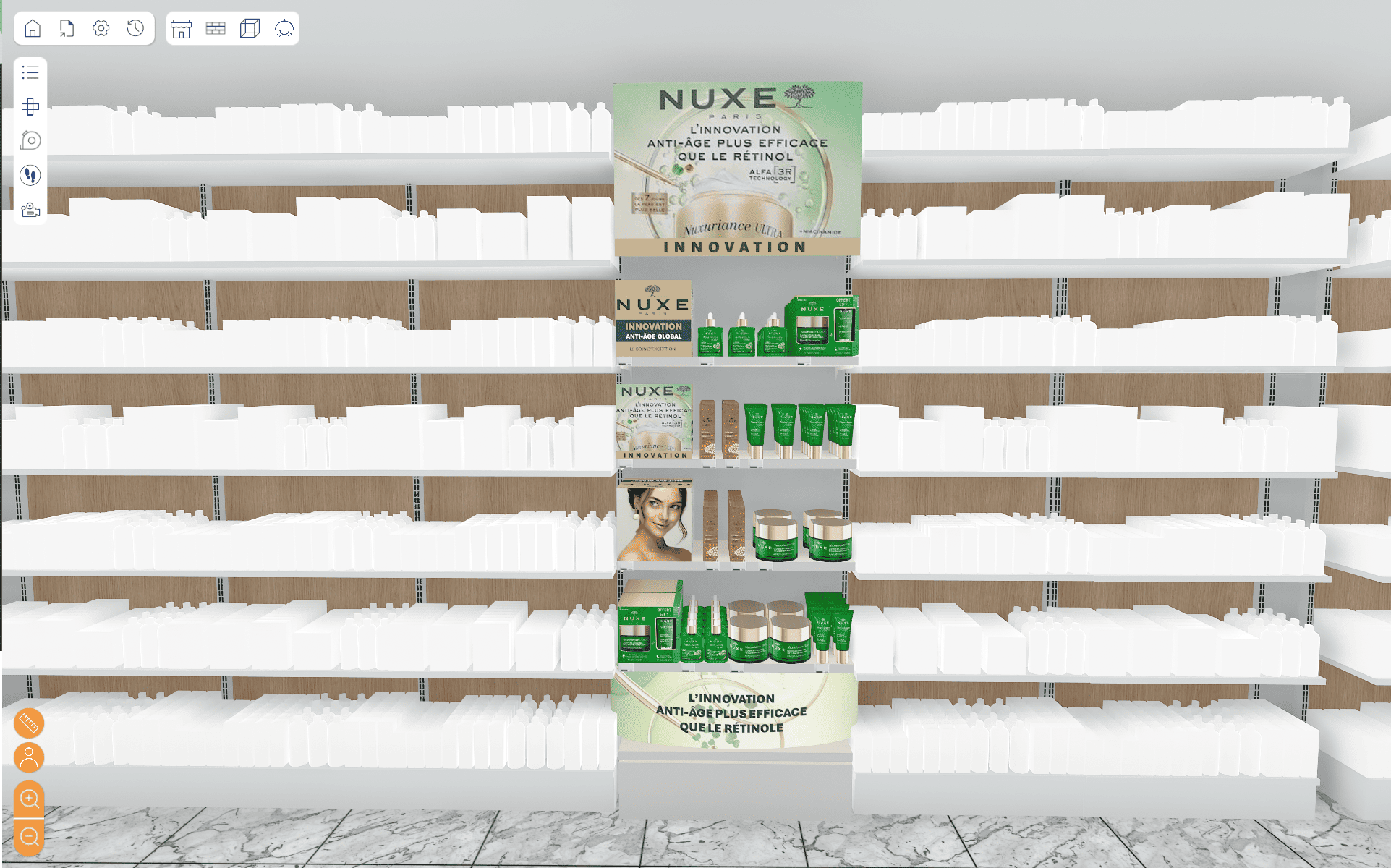
The MAM Baby case: a global leader in baby care accessories with a 77% market share in pharmacies, MAM Baby transformed its presentations to pharmacy category managers by integrating 3D simulation. The rate of new SKU listings increased 2- to 3-fold. Read the testimonial →
3. Rolling out guidelines internationally: the consistency challenge
For parapharmacy brands with an international network — Bioderma, La Roche-Posay, Nuxe, Pierre Fabre — rolling out merchandising guidelines to dozens of subsidiaries is a major logistical and educational challenge. Traditional 2D tools do not allow local teams to fully grasp headquarters' intent, or to properly adapt recommendations to their market realities.
Bioderma / Naos experienced this firsthand: with more than 45 subsidiaries worldwide, ensuring consistent pharmacy layouts while allowing for local adaptations (shelf size, regulatory constraints, shopping cultures) was an ongoing challenge. Integrating 3D simulation accelerated guideline adoption by subsidiaries and reduced misinterpretation.

4. Field compliance audits: measuring actual execution
A pharmaceutical sales rep visits 8 to 12 pharmacies a day on average. It is impossible to carry out a full layout compliance audit at every visit. Retail VR's image-recognition shelf audit feature changes this: the rep simply takes a photo of the shelf with a tablet, and AI automatically compares the observed layout with the recommended planogram. The compliance report is available within seconds.

This automated measurement capability transforms the rep's role: instead of time-consuming manual audits, a quick check frees up more time for advice and for building the relationship with the pharmacist.
5. Virtual shopper studies to test concepts in a pharmacy setting
Before rolling out a new parapharmacy aisle concept across a pharmacy network, Retail VR's virtual shopper studies make it possible to validate the configuration with real consumers — in an environment that faithfully reproduces the pharmacy, with competing products present and realistic lighting.
This approach is especially valuable in the pharmacy channel, where purchasing behavior is strongly influenced by contextual factors (the stress of illness, the search for advice, comparison with usual products). Testing under realistic virtual conditions before any physical rollout significantly reduces commercial risk.
Dashboard: the benefits of 3D merchandising for each player in the pharmacy channel
| Player | Main challenge | What 3D brings |
|---|---|---|
| OTC / pharma laboratory | Convincing pharmacists to list products and place them according to guidelines | Immersive 3D presentation + planogram adapted to each pharmacy format |
| Parapharmacy brand (e.g., Bioderma, La Roche-Posay) | International layout consistency across a diverse pharmacy network | Local simulation + 3D validation of subsidiaries' guidelines |
| Pharmacy owner | Optimizing parapharmacy space to maximize sales per m² | Planogram adapted to the pharmacy's actual dimensions |
| Pharmacy group (Giphar, Pharmabest...) | Standardizing concepts while allowing local adaptation | Aisle concept adaptable by format from a 3D library |
| Pharmaceutical sales rep | Getting shelves set up in line with the brand's recommendation | Field AR on a tablet to validate compliance at every visit |
The golden rules of pharmacy and parapharmacy merchandising
Rule 1 — Organize by care need, not by brand
Pharmacy shoppers look for a solution to their problem (acne, dry skin, digestion) before looking for a brand. Organizing the aisle by care category (hydration, sun protection, anti-aging, dermatology, supplements) encourages discovery and add-on sales. 3D lets you quickly simulate and compare both approaches (by brand vs. by need) before making a placement decision.
→ To go further: Need-based merchandising — the sliced bread aisle case shows how this approach applies in grocery retail, with lessons that carry over to the pharmacy channel.
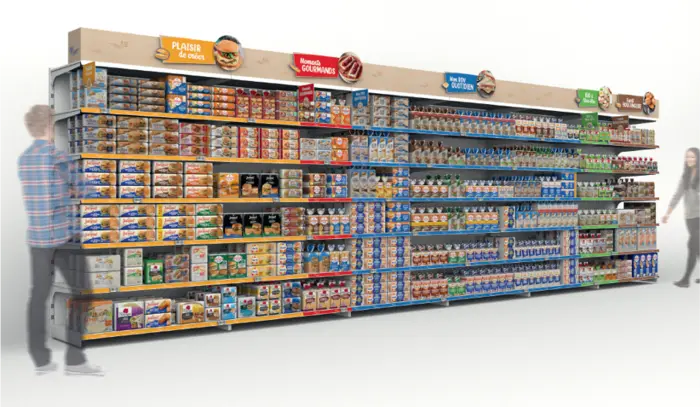
Rule 2 — Factor seasonality into your layout
The parapharmacy aisle is highly seasonal: SPF creams and sun care from May to August, immunity products and vitamins from September to February, allergy treatments in spring. A layout frozen all year round is a missed opportunity. Automatic generation of seasonal planograms in just a few hours, without re-entry, is one of the most tangible benefits of 3D in this sector.
Rule 3 — Optimize visibility zones by value category
In a pharmacy, not all shelves have the same commercial value. The eye-level zone (120–160 cm high) generates 2 to 3 times more sales than the bottom shelves. High-margin products and new launches should occupy these strategic zones. A 3D planogram lets you simulate exactly what shoppers will see at each height — and check the visibility of hero products from different angles.
Rule 4 — Adapt the planogram to each pharmacy's format
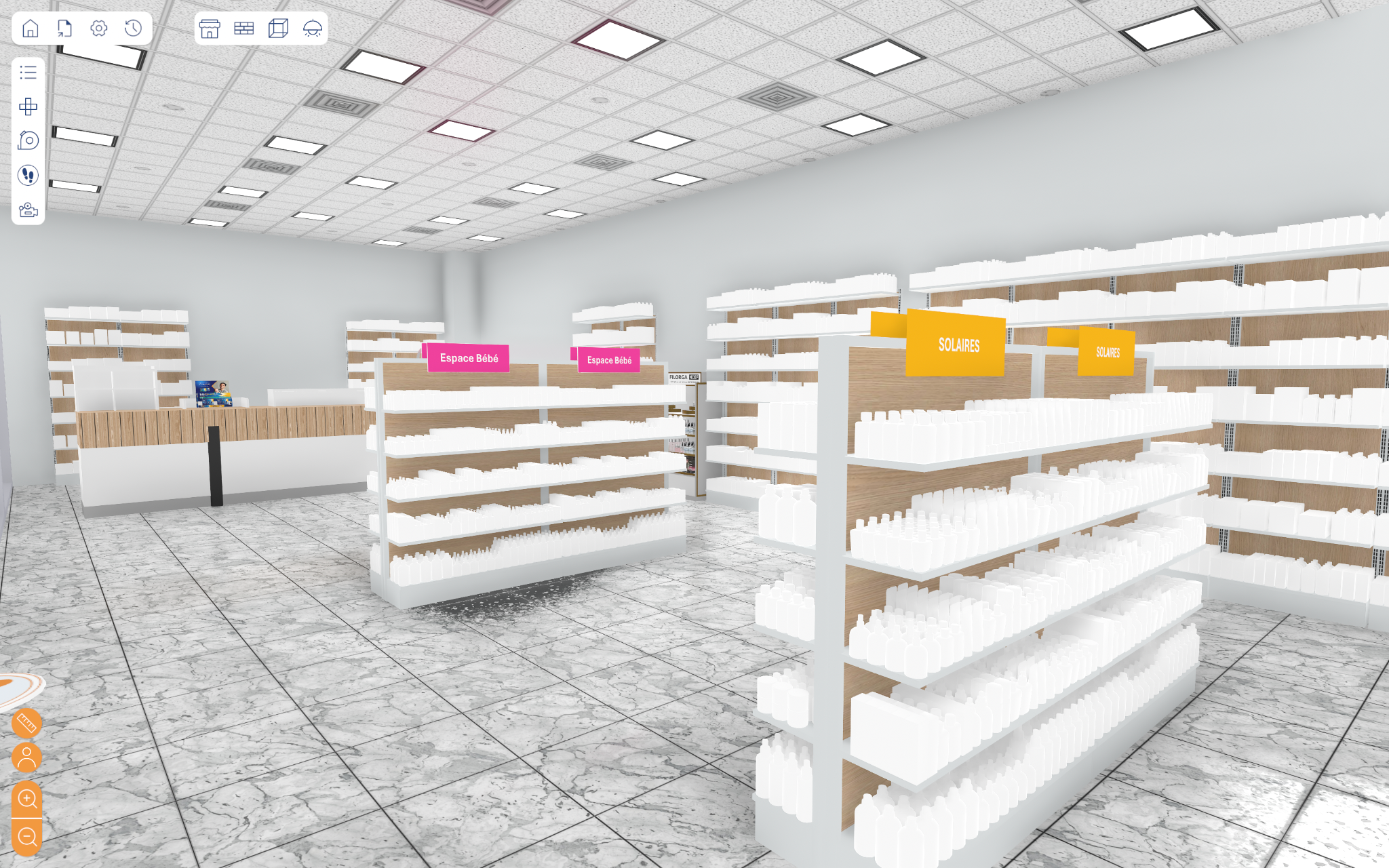
A placement recommendation designed for a large pharmacy with 30 m of shelving does not work in a pharmacy with 8 m. Each format requires an adaptation that, in 2D, means rebuilding the planogram by hand. In 3D, the same aisle concept is automatically adapted to the actual dimensions of each fixture, cutting customization work from several days to a few minutes.
Rule 5 — Measure compliance after every rollout
A merchandising plan that is not monitored quickly deteriorates. In pharmacies, resets are frequent (new product arrivals, promotions, different restocking), and laboratories' recommendations are not always followed. Field compliance measured by image recognition makes it possible to detect deviations from the very first visit after a rollout — and to take precise action.
Pharma merchandising KPIs: before / after 3D planograms
| Pharmacy merchandising KPI | Without a 3D tool | With a 3D planogram |
|---|---|---|
| Layout compliance rate | 40 – 60% | 75 – 90% |
| Concept validation lead time | 3 – 6 weeks | 2 – 5 days |
| Number of SKUs listed (laboratory) | Depends on relationships | +20% to +50% (immersive pitches) |
| Local adaptation rate of guidelines | Low (2D tool poorly understood) | High (adaptable simulation) |
| Display / POS material production cost | High (physical prototypes) | –40% to –60% (3D validation first) |
| Field team training time | Long (in-person training) | Short (intuitive AR on a tablet) |
The trends that will accelerate the digitalization of pharmacy merchandising
The rise of mega-pharmacies and structured pharmacy groups
Pharmabest, Giphar, Aprium, Pharmacie Lafayette — pharmacy groups are structuring their merchandising like true retail chains. They are developing standardized aisle concepts, professional planogram guides and performance measurement tools. 3D is naturally becoming the central tool in these organizations for designing, sharing and validating concepts.
The digitalization of the pharmaceutical sales rep's role
Equipped with a tablet running Retail VR's Instore Activation solution, a pharmaceutical sales rep can simulate the layout in real time in the pharmacy they are visiting, validate compliance with a photo and instantly share the visit report with headquarters. This digitalization of the field role cuts travel costs and improves the quality of merchandising execution.
Competing with mass retail on merchandising
Carrefour, Leclerc and other mass retail chains are investing heavily in their parapharmacy spaces. Carrefour has announced its ambition to double its parapharmacy market share within three years. Under this pressure, pharmacists and laboratories need to professionalize their merchandising — and 3D tools provide a clear competitive advantage over competitors that are still largely working in 2D.
AI for automatic optimization of pharmacy assortments
AI-powered assortment optimization solutions are starting to be deployed in the pharmacy channel. By combining sell-out data, seasonality, patient profiles and space constraints, AI automatically recommends the optimal assortment for each pharmacy format. Connecting to Retail VR's data merchandising platform makes it possible to feed these recommendations with real field data.
Conclusion: 3D, the new standard for pharmacy merchandising
The parapharmacy market is undergoing a major transformation. Independent pharmacies are defending their leadership against mass retailers that are investing heavily. OTC laboratories and dermocosmetics brands are competing for the best shelf positions in a tight and varied space. In this context, 3D pharmacy merchandising is no longer an optional competitive advantage — it is becoming the benchmark for players who want to win shelf share, improve their listing rate and ensure layout compliance.
Bioderma, MAM Baby and other leaders in the pharmacy channel have already adopted it. To discover how Retail VR can transform your approach to pharmacy and parapharmacy merchandising, explore our health and beauty customer cases or download our white paper on the benefits of 3D technologies in retail.
Ready to optimize your parapharmacy aisle with 3D? Request a demo →


.webp)
.webp)
.webp)

