

Background and origins of the metaverse
In the early 1990s, virtual reality was still not very popular with consumers and was mostly associated with scientific research.
It became more mainstream through movies and books that helped educate the public. Let’s look back at the origins of the metaverse and the pop culture that has grown up around it.
It was during this period that the term metaverse first appeared.
As a reminder, the term was coined in 1992 in the novel Snow Crash, written by Neal Stephenson. Science fiction has always been a favorite subject for novels, movies, and video games. It makes it possible to imagine the future of humanity while giving authors a great deal of creative freedom. Some novels are even adapted for the big screen. In this new article, we explore the movies and video games that echo the concept of the metaverse.
Before you start reading, we invite you to revisit the definition of immersive technologies.
The first metaverses: origins of the metaverse and pop culture
Active Worlds
Three years after Stephenson’s novel was released, the online virtual world Active Worlds was launched. After choosing a name, users log in and can explore a virtual world built by others. Based entirely on the novel Snow Crash, this first take on the metaverse concept allowed users to own worlds and universes and to develop custom 3D content. It also included web browsing, voice chat, and basic instant messaging capabilities.
Le Deuxième Monde
In 1997, Canal+ Multimedia, a subsidiary of the French TV group Canal+, developed “Le Deuxième Monde” (“The Second World”). This virtual universe was considered more of an immersive virtual reality software than a true video game. It was also the first time that fully custom stores were created for brands in a 3D universe. Le Deuxième Monde was discontinued four years later for editorial reasons.
The Second Life craze
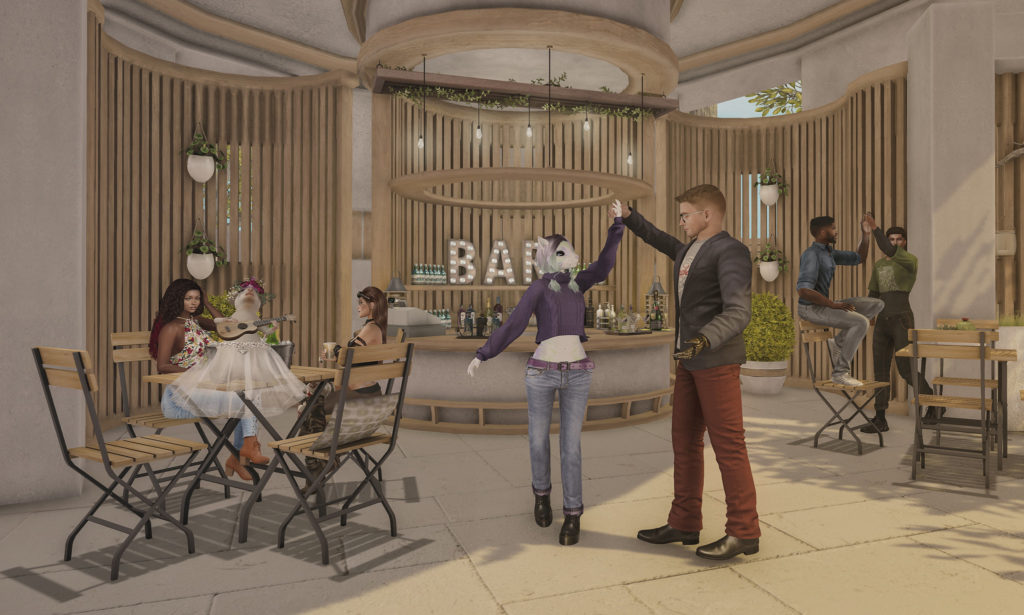
In 2003, “Second Life” arrived on the scene. Developed by Linden Lab, the game lets users live a second life in a virtual world. “Residents” can explore the world, meet other players, socialize, take part in individual and group activities, build, create, and buy and trade virtual goods and services with one another. The game is used for many purposes (non-exhaustive list):
- Dating and relationships: it is an immersive social platform that encourages meeting people and socializing.
- Education: used by many institutions such as schools, universities, libraries, and even companies for teaching practice or training sessions.
- Religion and communities of thought: as a social platform, it encourages people to meet, exchange ideas, and form groups based on their ideals.
- Work solutions: creating virtual workplaces, developing new prototypes, simulating business processes.
- Events and influence: creating events and promoting a company or its products within the virtual world.
The phenomenon grew very quickly, and by 2013 it had around one million regular users.
Plenty of criticism
The game faced a great deal of criticism. Like social networks, these virtual worlds are veritable data libraries. In September 2006, Linden Lab revealed that its Second Life database had been compromised and that customer information had probably been accessed.
In addition, a virtual world that gives users a lot of freedom often leads to inappropriate behavior. Some users look for activities they could do in the real world, such as socializing or exploring. Others, however, turn to actions they could not carry out in the physical world. In France, a conservative family association, Familles de France, sued Linden Lab in June 2007. It accused Second Life of giving minors access to sexual content, including bondage, bestiality, and scatology, as well as gambling and advertising for alcohol, drugs, and tobacco.
Between fraud, marketing abuse, technical issues, pornography, regulation, and user safety, these virtual worlds remain difficult to regulate and oversee. They can easily give way to excesses that raise real questions about safety and ethics.
The new generation: origins of the metaverse and pop culture
From Second Life to Roblox
A new video game arrived in 2006, this time aimed at children and teenagers: Roblox, a “sandbox” game. The goal is to build games and share them with the community so that others can visit them. To do this, the game provides a creation system based on the Lua programming language. Players can then browse a large catalog of games with their friends. Many genres have become popular: simulation, obstacle courses, hide-and-seek, escape games, and many more.
In August 2020, Roblox reported no fewer than 164 million monthly active users, more than half of whom were children under 16 in the United States. Roblox is a free-to-play game that generates revenue from in-game purchases made with a virtual currency called Robux. Players can buy this currency with real money or earn it by creating games: the more successful the games, the more Robux they are likely to bring in. All transactions go through this virtual currency, especially for customizing a character’s appearance by buying items such as hats and clothing. In 2020, Roblox decided to invest in one of its revenue streams: avatars. The company acquired the start-up Loom.ai, which specializes in creating realistic avatars.
Its technology enables:
- machine learning: an avatar can learn and reproduce its user’s personality traits.
- generating a 3D avatar from a 2D photo
This is exactly the kind of technology that could be used within the metaverse.
A world of virtual vices
These social platforms allow different groups of users to come together and share their ideals. As we have already seen with Second Life, games where freedom reigns often give rise to controversy.
Roblox is no exception, with 3 issues in particular:
- activism: an NBC News investigation revealed that around a hundred accounts were linked to extremist and even neo-Nazi politics. In addition, some extremist role-playing and scenario communities on Roblox sparked controversy.
- inappropriate content: a 2020 investigation by Fast Company found that sexual content was still widespread on Roblox, with moderators’ attempts to remove it compared to a game of “whack-a-mole.” The platform has also been heavily criticized for hosting sexually explicit games and images, even though such content is prohibited.
- microtransactions: Roblox was criticized for how easily children could spend large sums of money through microtransactions. Often made without their parents’ knowledge, these purchases led to refund requests, and the company sometimes deleted the accounts of players who requested them.
However, the publisher has also received a lot of positive feedback. It is known in particular for its fight against racism and its support for the Black Lives Matter movement. It has also put significant resources in place to create a safe environment for its young community:
- a chat filtering system
- 1,600 people employed for moderation
- parental control features
Overall, the situation has generally improved in recent years.

The Fortnite giant
Fortnite is an online game developed by Epic Games, with a first beta version released in 2011. It comes in several game modes that share the same overall gameplay and game engine. It has three different modes:
- Save the World (2011): lets one or more players progress through a story where the goal is to eliminate creatures and rescue humans.
- Battle Royale (2017): lets players compete solo or in teams on a map that shrinks as the match goes on until only one winner remains.
- Creative (2018): lets players build their own worlds inside the game.
Fortnite emerged at a time of huge enthusiasm for the Battle Royale genre.
While both games were a success for Epic Games, Fortnite Battle Royale became a social phenomenon. It attracted more than 125 million players in less than a year and generated hundreds of millions of dollars per month. In 2019, Epic Games announced that Fortnite had 250 million players, twice as many as in June 2018.
Late and unprecedented controversies
- The first came in 2019 over its random reward system. Players can buy a “loot box” with real money. It contains unknown loot whose value varies greatly. This practice, also found in the famous FIFA series, could be considered gambling given how much chance is involved. French public authorities have even looked into the issue.
- The second controversy came in 2020, when Apple and then Google removed the game from their app stores. The reason: the game allowed in-app purchases without going through the stores’ payment platforms. No commission could therefore be collected, which led to conflicts between the three giants.
- In November 2021, China made Fortnite inaccessible as part of its tightening regulatory policy on digital usage.
-

Cinematic illustrations: origins of the metaverse and pop culture
In the 21st century, many works echo the metaverse. Some have been resounding successes.
The Matrix
First released in 1999, this is a particularly well-known film. This science-fiction story depicts humans living in a virtual simulation called “the Matrix.” The environment was created by intelligent machines seeking to enslave humanity. When the main protagonist discovers the truth, he launches a rebellion.
This dystopian film has given rise to many theories, notably that reality is hidden from us.
Black Mirror
This series questions the unexpected consequences that new technologies could have. First aired in 2011, its title refers to the omnipresence of screens in our societies, from a dystopian and satirical angle. Innovation is often praised for its qualities and benefits; this series, on the other hand, takes the opposite view to question and warn. Several episodes, such as Playtest, San Junipero, and Striking Vipers, echo virtual reality or a form of metaverse.
Ready Player One
Released in 2018, this science-fiction film is an adaptation of Ernest Cline’s novel Ready Player One. In a chaotic world ravaged by war, famine, and climate change, survivors take refuge in a virtual universe: the OASIS. Over time, it has become a genuine human society that replaces the real world. Accessible through a virtual reality headset, players can move around, chat, and take part in many activities through their avatars. This global game is both exciting and expensive if you want to acquire the accessories and weapons needed to win. The goal is to find 3 keys to obtain the Easter egg left by the game’s creator. Once it is found, the winner becomes the owner of the OASIS and pockets 500 billion dollars.
A world that makes people dream
Whether in books, video games, or movies, virtual reality and the metaverse are hugely popular subjects because the possibilities are endless. These virtual universes can be shaped at their creators’ will, as a way to escape a diminished or dull real world. While many works focus on the innovative and beneficial nature of this technology, others, like Black Mirror, question its limits and dangers.
The various controversies around safety and technical issues raise questions about the feasibility of such an environment in our modern societies.
Will we see a metaverse built on Meta’s vision in the coming years?


.webp)
.webp)
.webp)

