


The checkout area: the last meter of the customer journey, and the most profitable per square meter
The checkout area is retail's great paradox: often overlooked in the overall merchandising strategy, it is nonetheless one of the most profitable spaces per square meter. Shoppers waiting at the checkout are a captive audience, their basket is already filled, and their state of mind is conducive to impulse buying. According to several behavioral studies, 10 to 20% of a hypermarket's impulse sales revenue comes from the checkout area, which takes up less than 3% of the store's total floor space.
Sources: Optimizing the in-store shopping journey — Almapay · In-store merchandising — Nestore
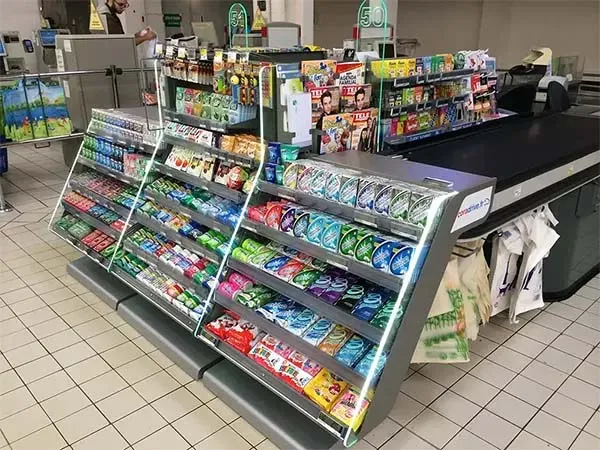
The fundamentals of checkout area merchandising
Why shoppers buy at the checkout
- Visibility: shoppers are standing still (in line) and their eyes scan their immediate surroundings. A product well placed at eye level naturally catches their attention.
- Exposure time: the wait lasts 2 to 5 minutes on average, more than enough time to trigger a craving.
- Low perceived risk: products offered at the checkout are generally low-priced. The decision is quick and requires no deliberation.
- Complementarity: consistency with the main purchase plays a key role (chocolates in a bookstore, batteries in a consumer electronics store).
💡 Did you know?
Beyond a 5-minute wait, nearly 3 out of 4 customers would rather abandon their purchase, according to Almapay data. Reducing wait times AND optimizing the checkout assortment are two complementary levers.
Sources: Checkout wait times and their impact — Almapay
The most common checkout area mistakes
- Assortment too broad: too many SKUs overwhelm shoppers. The checkout area calls for a limited, focused assortment.
- Insufficient facings: a single facing means an out-of-stock after the first sale.
- Infrequent refreshes: a checkout assortment that hasn't changed in 6 months no longer drives impulse purchases.
- Poorly sized POS displays: they block the view of adjacent checkouts and create frustration.
- Inconsistency with the season or current promotions.
How 3D simulation optimizes checkout area merchandising
Testing the shopper experience in the checkout line
Retail VR's virtual shopper studies make it possible to analyze the behavior of a panel of consumers in a virtual checkout line: gaze zones (eye-tracking), products that make the eye stop, the impact of placement height on pick-up rate, and the effect of fixture density.
Testing multiple configurations without physical fixtures
Linear display or crisscross shelving? A height of 80 cm or 110 cm? These questions can be tested in a few hours with 3D simulation, compared with several days when building physical prototypes. For retailers with 300+ stores, that represents considerable savings in time and budget.
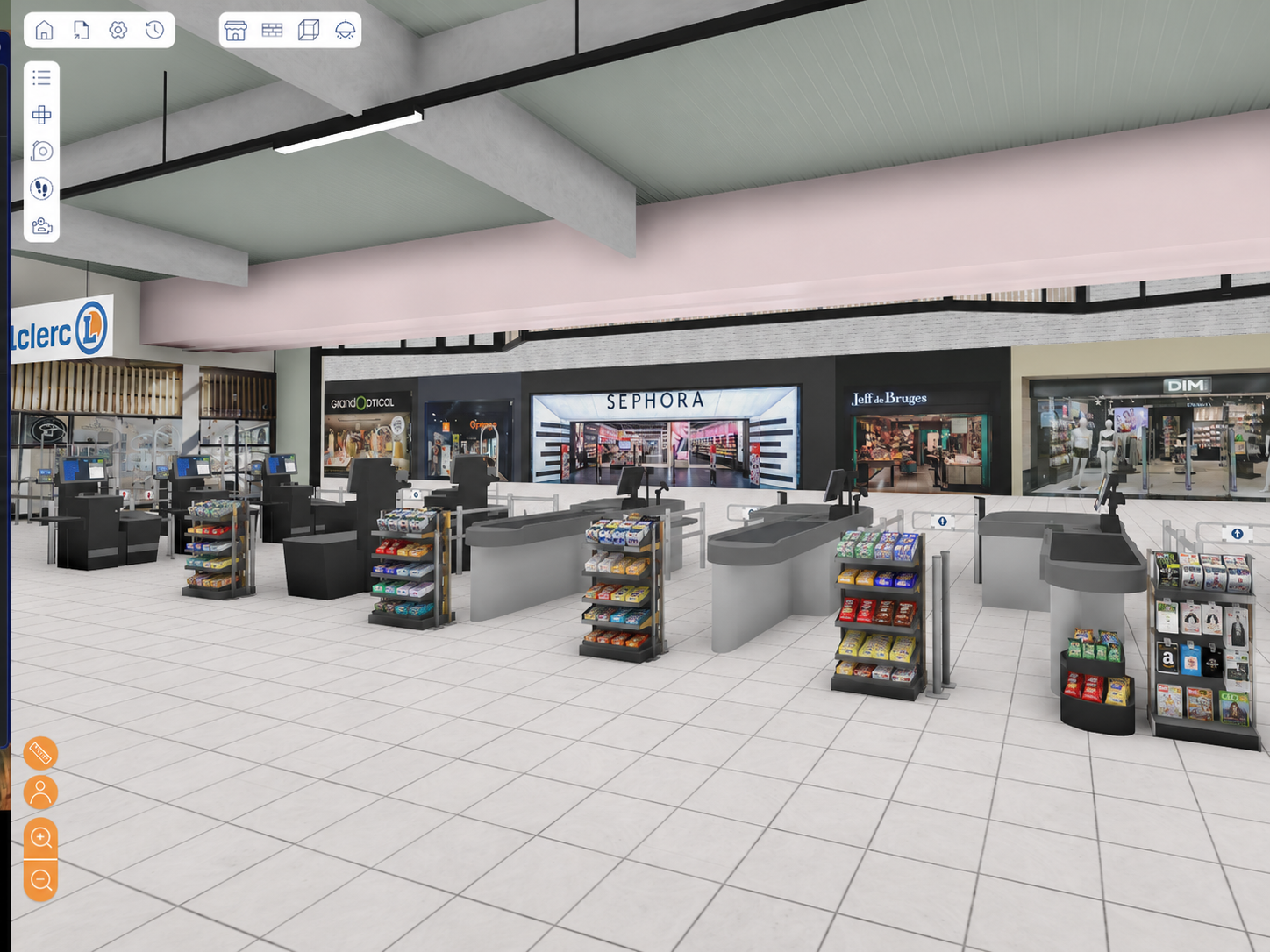
Adapting by store format
A hypermarket checkout area (15 to 20 checkouts, very high traffic) doesn't have the same constraints as a convenience store (2 to 3 checkouts). Retail VR's 3D planogram software lets you create variants by format and roll them out consistently across the entire network.
The categories that perform in the checkout area
| Category | Why it works | Golden rule of merchandising | Target height |
|---|---|---|---|
| Confectionery / chocolates | Impulse treat purchase, low price | Wide facings, monthly refresh | Children 80 cm Adults 110 cm |
| Batteries / electronic accessories | Last-minute reminder of a need | Strong "don't forget!" signage | Eye level |
| Magazines / press | Something to do while waiting, clear line of sight | Title visible from a distance | 130 – 150 cm |
| Coffee capsules / pods | Habitual reflex purchase by regulars | Wide facing; out-of-stock = direct loss | Eye level |
| Phone chargers / cables | Urgent, unplanned need | Packaging readable in 2 seconds | Eye level |
| Gift vouchers / cards | Last-minute gift | Dedicated display, clear signage | Checkout |
Conclusion
In 2026, the checkout area remains one of the most underused and most profitable merchandising spaces in retail. Well-executed optimization (a calibrated assortment, tested heights, seasonal refreshes) can deliver several additional points of margin without any investment in floor space. 3D simulation and virtual shopper studies make it possible to reach this optimum with no risk and no prototyping costs. Contact the Retail VR teams to optimize your checkout areas.
Want to learn more? Request a demo →


.webp)
.webp)
.webp)

