


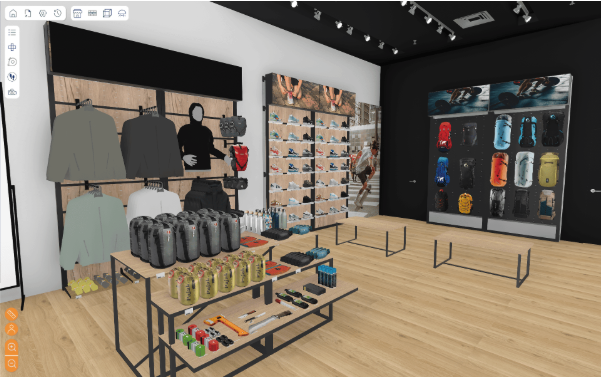
With €16.09 billion in revenue in 2025 and 61% of French people practicing a sport regularly, the sporting goods market is one of the most dynamic sectors in French retail. But it is also one of the most complex to merchandise: extreme seasonality, widely varying store formats, very high SKU density (Decathlon alone offers 25,000 SKUs across 80 sports), and intense competitive pressure between generalists and specialists. In this context, merchandising has become a central lever for differentiation. And 3D simulation — immersive planograms, virtual shopper studies, in-store audits using image recognition — is profoundly transforming how merchandising teams work in this sector.
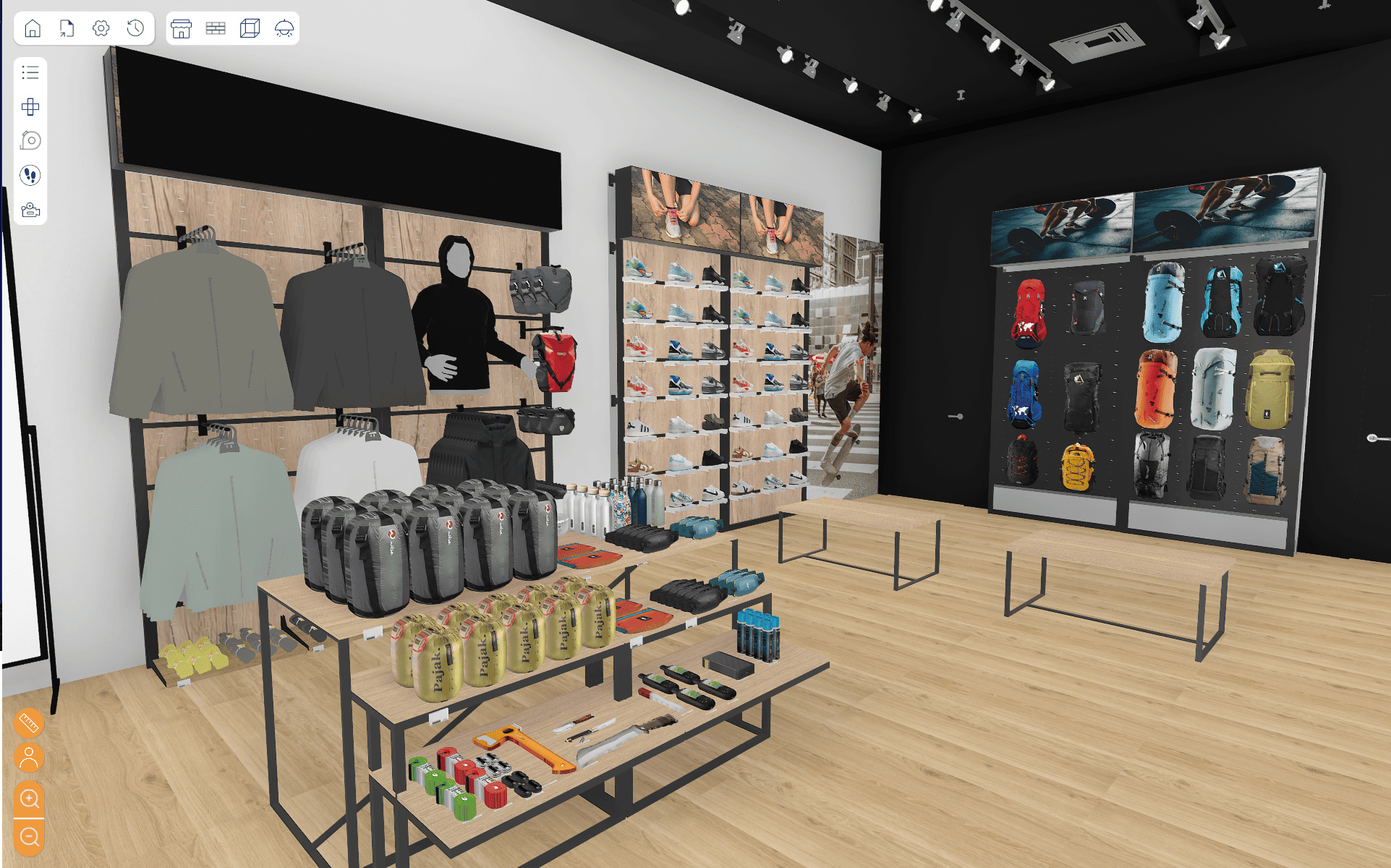
The sporting goods market in 2026: key figures and merchandising challenges
A market reshaping itself after a decade of growth
The French sporting goods market has enjoyed a decade of strong growth, driven by post-Covid effects and the Paris 2024 Olympic Games. In 2026, the market is entering a consolidation phase in which differentiation through the in-store experience and the quality of merchandising becomes decisive. Decathlon, the undisputed leader, invested €69 million in 2025 to modernize 85 stores — around a hundred more will be renovated in 2026. Intersport modernized 130 stores in 2025 and is accelerating its store renovation strategy.
| Retailer | 2025 revenue in France | Change | No. of stores |
|---|---|---|---|
| Decathlon #1 | €4.98bn (business volume) | +2.3% in France | ~350 |
| Intersport | ~€4bn | +6.3% in 2024 | ~750 |
| Sport 2000 / Céraclès | ~€1.3bn targeted by 2030 | 1,000-store plan | ~700 |
| Au Vieux Campeur | Premium outdoor specialist | CSR leader | ~30 |
| Courir | Running / sneaker specialist | Steady growth | ~300 |
Sources: EPSIMAS — French sporting goods market 2025 · LSA — Decathlon 2025 results · LSA — Intersport 2025
What makes sports merchandising particularly complex
- Extreme seasonality: running and trail in spring, swimming and outdoor in summer, soccer and rugby in the fall, skiing and winter sports in winter. Up to 50% of the sales floor in a general sporting goods store is reassigned every quarter.
- Widely varying formats: an 86,000 sq ft Decathlon has nothing in common with a 2,150 sq ft specialty running store. Yet the same brands (Adidas, Nike, Salomon) have to adapt their planogram recommendations to both.
- SKU density: Decathlon offers 25,000 SKUs, Intersport more than 50,000. Space management by category — how many linear meters for running vs. soccer vs. cycling — is a constant trade-off.
- Complex cross-merchandising: a pair of trail shoes is never sold on its own — it calls for technical socks, a hydration pack, poles. Organizing the shelf around activities rather than product categories is a major revenue lever.
- Pressure from private labels: Decathlon (Quechua, Kalenji, B'Twin) and Intersport (Energetics, McKinley) have strong private labels that coexist with the major national brands. Allocating facings is an ongoing negotiation.
Sources: Tudigo — Outdoor equipment market 2026 · Xerfi — The outdoor sports market
5 merchandising challenges specific to sports retail
1. Planning seasonal transitions without disruption
The transition between two seasons is the most critical moment in sports merchandising. Switching from the ski department to garden and outdoor, from indoor running to outdoor trail — these changeovers must be prepared weeks in advance, with planograms ready to roll out on day one. In 2026, an equipment manufacturer that shows up with a 3D simulation of its seasonal shelf concept, already adapted to the store format of the buyer it is meeting, gains a decisive edge over its competitors.
Retail VR's automatic 3D planogram generation makes it possible to create these seasonal variations in a few hours and roll them out across an entire network via the collaborative cloud platform.
2. Organizing cross-merchandising by activity
Sports shoppers rarely buy just one product. They buy into a complete activity: the trail runner wants shoes, socks, a pack, and nutrition. Organizing the shelf by activity rather than by product category is a powerful lever for increasing average basket size — but hard to test without prior simulation.
Retail VR's virtual shopper studies make it possible to test different shelf layouts (by brand vs. by sport vs. by skill level) with a consumer panel and measure the impact on time spent at the shelf, product pick-ups, and conversions — before any physical rollout.
3. Managing the coexistence of national brands and private labels
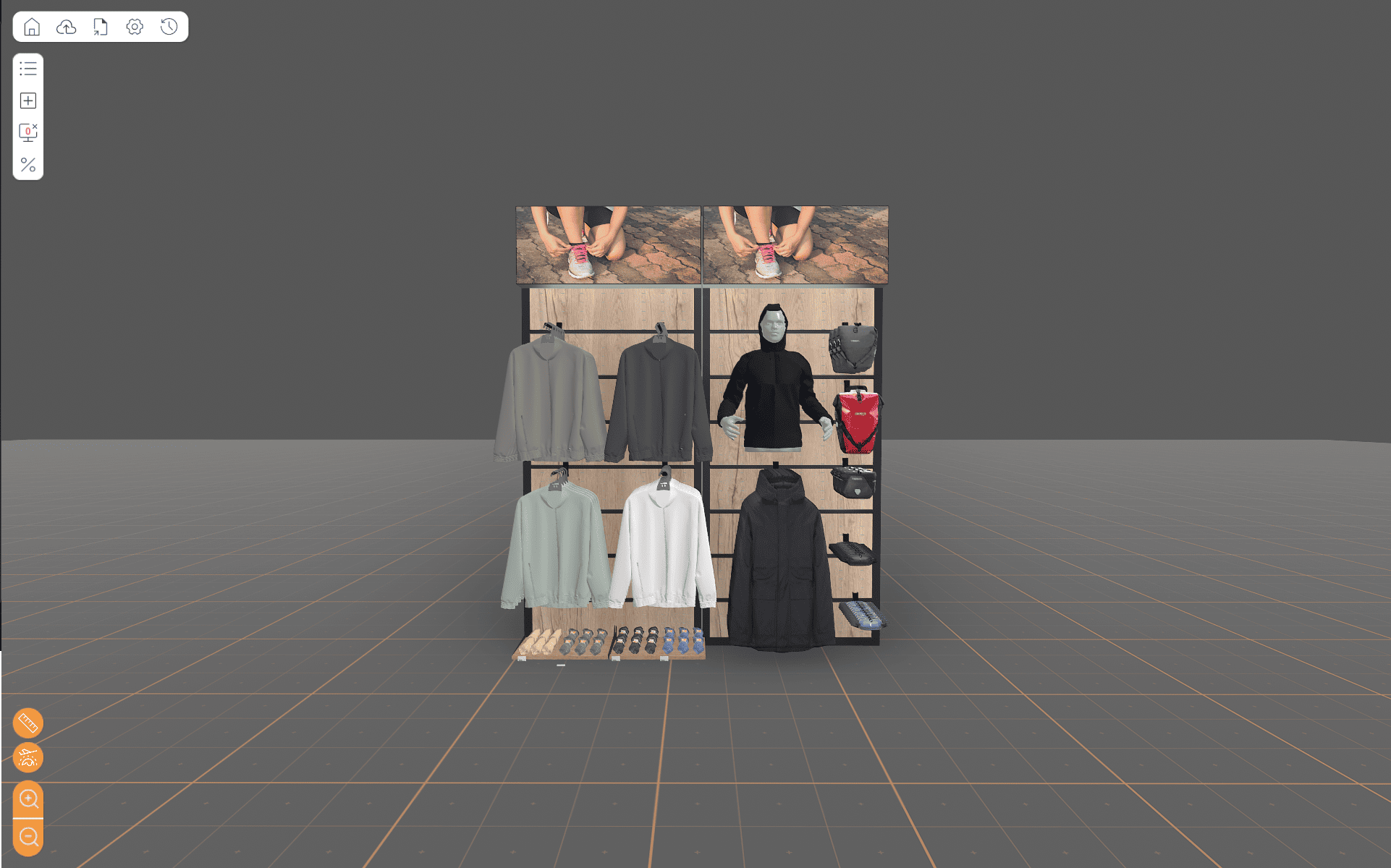
The battle for facings between national brands (Nike, Adidas, Salomon, The North Face) and retailers' private labels (Quechua and Kalenji at Decathlon, Energetics at Intersport) is the core commercial issue in sports merchandising. For an outdoor equipment manufacturer, defending its shelf space against a well-established private label requires solid arguments — including an immersive 3D presentation of the shelf as it should be, with its products properly positioned.
Mixed reality presentations during the meeting with the retailer's buyer transform the negotiation: the buyer sees the finished shelf, instantly understands the recommendation, and makes a decision on the spot.
4. Staging major brands' corners and shop-in-shops
Nike, Adidas, Salomon, Rossignol — major sports brands are investing heavily in dedicated corners within multi-sport retailers. These branded spaces (shop-in-shops) require precise visual staging: branded fixtures, signage, lighting, POS materials. These concepts were traditionally validated using costly physical mock-ups. With 3D simulation, validation happens virtually in a matter of hours.
The Virtual First method makes it possible to design, test, and validate these corners in immersive 3D before the fixtures are physically produced, reducing errors and prototyping costs.
5. Ensuring compliance across networks of several hundred stores
Intersport has 750 franchised stores, Sport 2000 around 700, and Courir 300. Ensuring planogram compliance across such a network is a colossal task. Retail VR's AI image recognition shelf audit feature allows field sales reps to photograph the shelf during their visit and instantly get a compliance report against the recommended planogram.
Priority sports departments for 3D optimization
| Department / Activity | Merchandising specifics | Priority 3D lever | Seasonality |
|---|---|---|---|
| Running / Trail | Highly technical, expert advice, brand loyalty | Brand corner simulation + nutrition cross-merchandising | Spring / Summer |
| Cycling / Micromobility | Bulky products, in-use display | Virtual Showroom by store format | Spring / Summer |
| Skiing / Winter sports | Highly seasonal, fast turnover | Automated seasonal planogram in 48h | Fall / Winter |
| Soccer / Team sports | Collection refreshed twice a year | Jersey facing management by club / team | Back-to-sport (Aug–Sept) |
| Fitness / Yoga / Wellness | Strong growth, predominantly female shoppers | Shelf staging by skill level | Year-round |
| Outdoor / Hiking | Premium technical ranges, considered purchase | Activity-based zones + educational 3D POS | Spring / Summer |
Sources: INJEP / Crédoc — Sports participation in France 2025 · Union Sport & Cycle — Bike market 2024
Real-world examples: how sports retail brands use Retail VR
Jamini — Visual merchandising and team training with the Virtual Showroom
Jamini, a high-end textile and home decor brand, shows how a Virtual Showroom can transform both the customer experience and the training of sales teams in visual merchandising. Although positioned in textiles and home decor rather than sports, this case perfectly illustrates the challenges of seasonal shelf staging and field training that lie at the heart of sports retailers' concerns. The brand saw a 90% increase in online revenue after deploying the Virtual Showroom, and also uses the tool internally to train its teams in mix & match and visual merchandising techniques.
| Online revenue | +90% after deploying the Virtual Showroom |
| Team training | Internal visual merchandising training tool |
| Accessibility | Remote customers immersed in the brand universe without traveling |
| Conversion | Higher average basket and conversion rate |
H2O at Home — Launching a new collection to a network of 5,000 people
H2O at Home, an eco-friendly cleaning products brand sold through direct sales, used Retail VR's Virtual Showroom solution to present a new collection to its network of sales consultants. The virtual event made it possible to reach 5,000 people, compared with the usual 1,000 in person. This case shows the power of 3D for large-scale seasonal launches — the same challenge faced by sports brands that must present their new running, ski, or outdoor collections to their sales networks every season.
| Network reach | 5,000 people reached vs. the usual 1,000 in person |
| Accessibility | Nationwide network covered without travel |
| Presentation quality | 360° showroom as a substitute for the physical showroom |
| Adoption | Intuitive interface, positive feedback from the entire network |
→ Read the H2O at Home testimonial →
How 3D is concretely transforming sports merchandising in 2026
From seasonal design to the store floor in 2 weeks
The traditional seasonal planning cycle in sports — from planogram design to in-store rollout — takes 6 to 10 weeks on average with a conventional approach. With the Virtual First method, this cycle is cut to 2 to 3 weeks:
- Week 1: the seasonal shelf concept is created in 3D simulation and automatically adapted to each store format.
- Week 2: collaborative cloud validation with regional teams and retail buyers. Real-time changes based on feedback.
- Week 3: in-store rollout using an augmented reality implementation guide on tablet. Automated compliance audit from day 2.
Presenting to sports buyers: from PDF sheets to an immersive 3D pitch
An outdoor equipment manufacturer (backpacks, tents, technical apparel) that presents its planogram recommendation in immersive 3D during its meeting with a Decathlon or Intersport buyer immediately stands out. The buyer — who receives dozens of proposals every week as PDF files or 2D diagrams — sees, for the first time, the shelf exactly as it will be, with the brand's products in place.
This persuasion mechanism, documented at Nestlé Waters (+35% of plans approved at the first presentation — see the testimonial) and at MAM Baby (2–3× higher listing rate — see the testimonial), works just as effectively in sports.
Compliance audits across franchise networks
Intersport, Sport 2000, and Courir are franchise networks. Each franchisee runs its day-to-day operations independently — which creates significant gaps between the recommended planogram and the reality on the shelf. Retail VR's AI image recognition allows the brand's sales rep to photograph the shelf during a visit and instantly get a compliance report. No more tedious manual audits.
Sports merchandising KPIs: before / after 3D simulation
| KPI | Without a 3D tool | With Retail VR 3D |
|---|---|---|
| Seasonal planning cycle length | 6–10 weeks | 2–3 weeks |
| In-store planogram compliance rate | 40–60% | 75–90% |
| Approval rate at first buyer presentation | 40–60% | 75–90% (+35% observed) |
| Cost of a corner / shop-in-shop prototype | €8,000–€20,000 | < €1,000 (3D validation) |
| Field team training time | 2–4 weeks | 3–5 days (AR on tablet) |
| Reach of a collection launch (network) | 1,000 people (in person) | 5,000+ (virtual event) |
CSR and sports merchandising: a sector under environmental pressure
The sports sector is particularly exposed to CSR issues: technical products with high plastic and synthetic content, seasonality that generates end-of-season surplus stock, and major brands' POS materials produced in massive quantities. 3D simulation fits naturally into this approach: every corner prototype that isn't built and every POS display validated virtually before production means materials saved and CO₂ emissions avoided.
Decathlon was named the CSR leader in the sports sector in the 2025 Ipsos barometer. Au Vieux Campeur retains its crown on this criterion. In 2026, manufacturers that bring a documented Virtual First approach and a quantified record of avoided POS materials have a differentiating argument in tenders from the most advanced retailers.
Sources: Ipsos/Bonial sports barometer 2025 — Decathlon CSR · Retail VR — Eco-designed POS and 3D prototyping
Conclusion
In 2026, the sports and outdoor market is at a turning point: after a decade of strong post-Covid growth, competition now hinges on the quality of the in-store experience and the effectiveness of merchandising. Decathlon is investing €69 million to renovate its stores. Intersport is modernizing 130 stores a year. In this context, sports manufacturers and brands that master the entire merchandising cycle — from seasonal 3D simulation to the immersive buyer pitch, from augmented reality field guides to automated compliance audits — gain a measurable operational and commercial advantage.
To find out how Retail VR supports sports retail players, from designing seasonal planograms to in-store execution across franchise networks, discover our 3D merchandising solution or explore our customer cases.
Ready to optimize your sports shelves with 3D? Request a demo →


.webp)
.webp)
.webp)

