

In 2026, merchandising is no longer just a tool for showcasing products: it has become a real driver of economic efficiency.
Faced with growing pressure on margins and the operational complexity of their networks, brands and retailers are rethinking their approaches to reconcile sales performance and cost control.
Thanks to advances inartificial intelligence and immersive 3D, merchandising is being transformed into a strategic management discipline. Planograms are automatically optimized from data, concepts are virtually tested before deployment, and every linear meter becomes measurable in terms of profitability.
In other words, merchandising in 2026 is no longer a decorative function: it's an analytical and decision-making function, at the service of rationalization, sustainability and return on investment.
Streamlining with AI-assisted merchandising management
Management merchandising is the basis of all sales efficiency.
He determines where and how to place products to maximize shelf performance.
But today, thanks tolayout AI, this approach is entering a new dimension:
-Intelligent planograms are automatically generated from sales data and space constraints.
-The AI instantly simulates several scenarios to identify the one offering the best yield per linear metre.
-Decisions are no longer based on intuition, but on concrete, measurable predictions.
The result: less time spent testing, fewer layout errors, and optimized plans right from the first iteration.
Management merchandising thus becomes a lever for productivity and logistics cost reduction.
Visual merchandising: from an expense to a performance driver
Visual merchandising, historically considered a creative and therefore costly job, is changing its face.
Until now, creating a store concept, testing a new layout or designing an experiential department required physical prototypes, photo shoots, team travel... all time-consuming and costly steps.
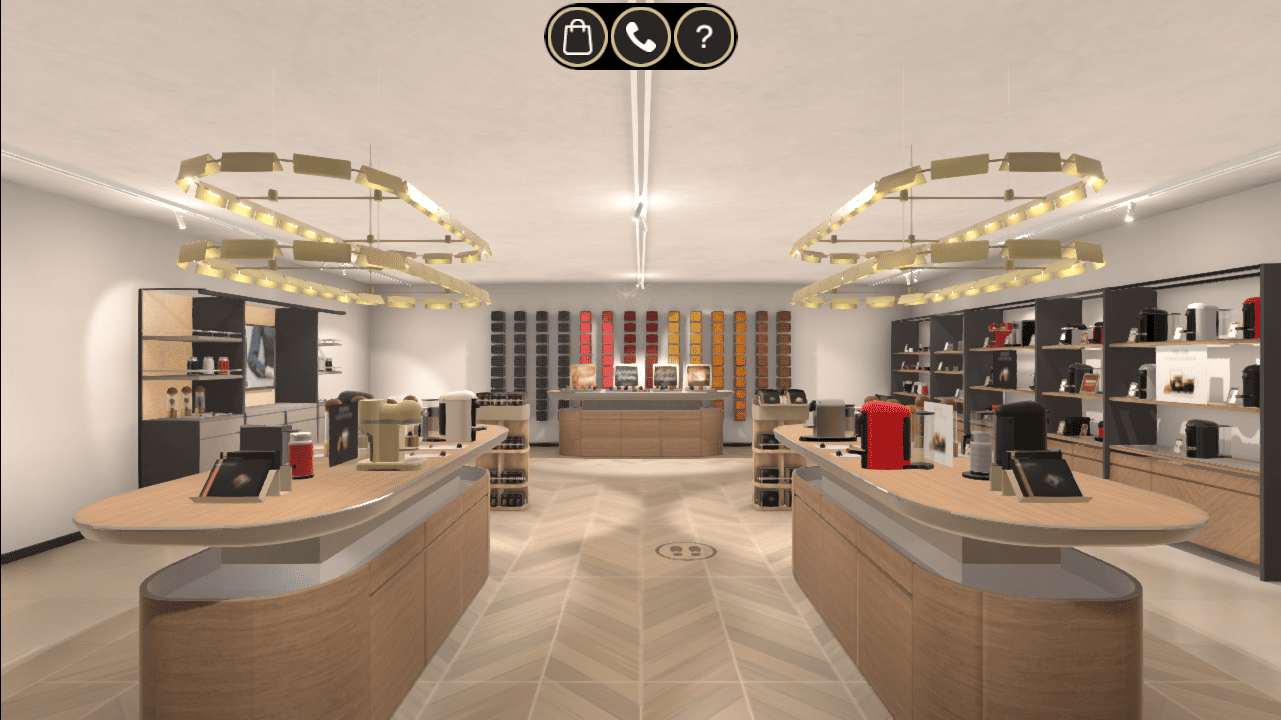
Thanks to 3D reconstruction and immersive simulation, all this can now be done virtually, at marginal cost:
- Spaces are modeled in photorealistic 3D.
- Teams test different layouts without leaving their desks.
- Concepts are validated before any physical production takes place.
Every change is made in just a few clicks: no more layout costs, no more shipping, no more physical retouching.
Visual merchandising becomes a profitable, measurable and widely replicable digital experience
A unified approach: from data to decision-making
The strength of technologies like Retail VR lies in bringing these two worlds (management and visual) together on a single platform.
AI-generated planograms can be visualized, tested and validated in a realistic 3D environment.
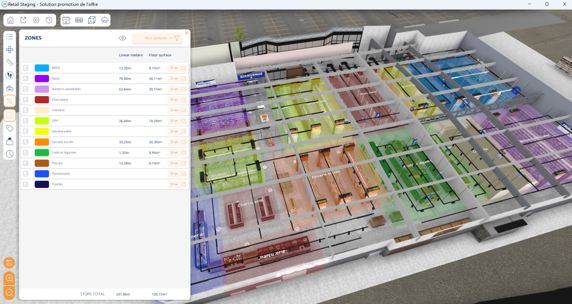
Simulations can be enhanced with behavioral data (eye-tracking, hot zones, customer paths).
This link between analysis, visualization and decision-making is transforming the way we work:
- Merchandising departments have a global, agile management tool.
- Field teams save time and avoid costly mistakes.
- Partners and decision-makers can project themselves into a virtual concept validated by data.
Merchandising thus becomes a tool for economic governance as well as a lever for creativity.
2026: merchandising, a profit center rather than a cost center
In 2026, the most successful retail departments will no longer consider merchandising as an expense, but as a strategic investment.
The benefits are clear:
- Reduce design time: up to -50% on project cycles
- Fewer physical prototypes: -70% on test and mock-up costs
- Better shelf allocation: +10 to 15% performance per m².
- Accelerated decision-making: concept validation in a matter of days
- Enhanced eco-design: less transport, less waste
These gains, combined with greater operational precision, make merchandising one of the most powerful levers for rationalizing retail costs.
In conclusion: 360° efficiency
Merchandising in 2026 is no longer a question of aesthetics, but of strategy.
Thanks to the fusion of AI, 3D and immersive simulation, it becomes the pillar of a faster, more sustainable and more profitable approach.
Retail VR is an integral part of this transformation:
by offering brands and chains the ability to design, test and validate their concepts virtually, while drastically reducing implementation costs and risks.
In 2026, merchandising is no longer a showcase: it's a weapon of rationalization.


.webp)
.webp)
.webp)

