

Background
A quick refresher on merchandising basics
Before looking at the various innovations, let's go back over the basics of merchandising.
According to the French Merchandising Institute (now the Institut du Commerce), merchandising is "a set of studies and applied techniques, implemented separately or jointly by retailers and manufacturers, with a view to increasing the profitability of the point of sale and product sell-through, by continually adapting the assortment to market needs and presenting goods appropriately."
The core objective is to maximize sales or margins by encouraging consumers to buy through the sales channel. Optimizing merchandising relies on quantitative analyses of sales and financial results (revenue, margins, panel data, etc.). It also draws on showcasing the offer and on taking into account visitor behavior in the store (shopping paths, consumption habits, traffic speed, visual behaviors and abilities, etc.).
Macro and micro merchandising
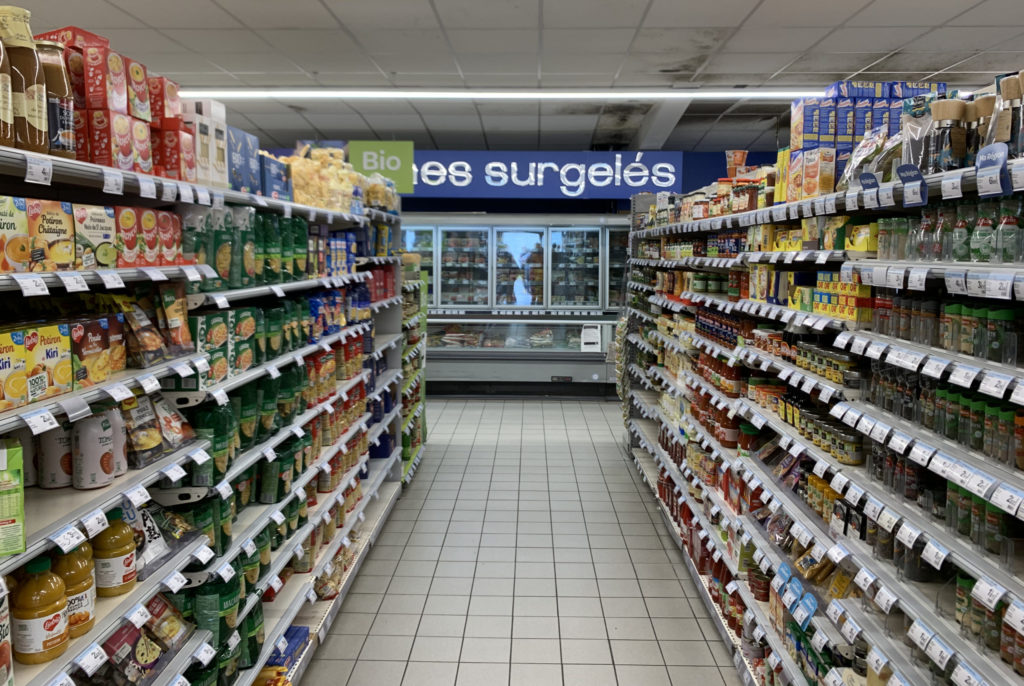
Macro merchandising is the optimization of the customer journey. It covers the layout of categories and the placement of shelving in the store. The idea is to position the different store areas along customers' main traffic routes (entrance aisle and main aisle). These areas bring together several categories containing complementary and substitute products. Macro merchandising also takes other parameters into account, such as aisle width, foot traffic and gondola height.
Micro merchandising is the optimization of the shelves. It consists of putting the right product, the right range and the right assortment in front of customers on the shelves. This means adjusting how products are arranged on the shelves according to customer needs and market characteristics.
When planned in parallel, these two aspects show retailers how to organize their store optimally and generate maximum revenue or margin. They also help deliver the ideal product assortment on the shelf. This ties in with visual merchandising, which aims to optimize product presentation and the satisfaction of customers, visitors and staff. And, of course, to drive sales.
E-merchandising
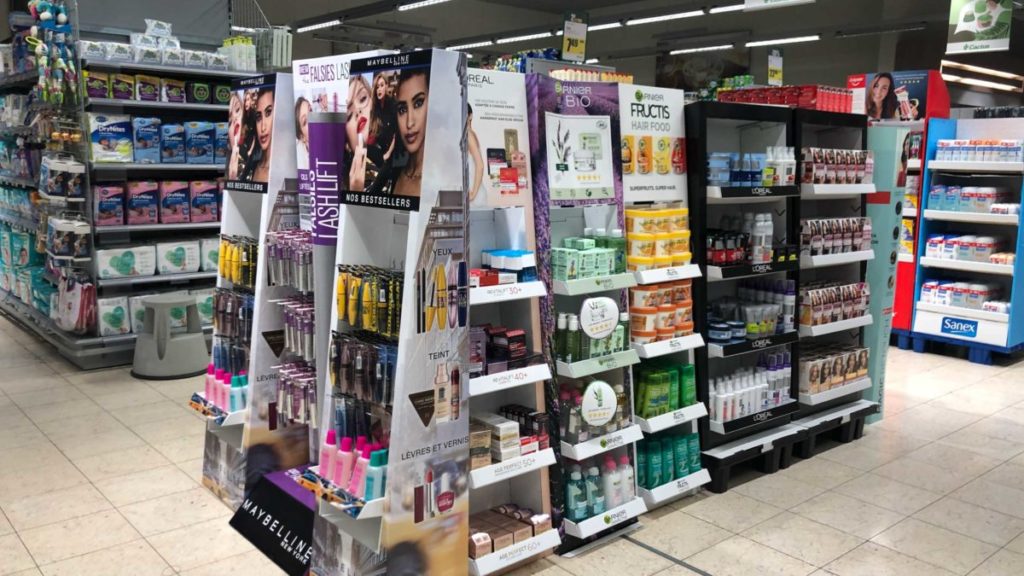
It is simply the extension of physical merchandising adapted to the web. In the same way, e-merchandising seeks to optimize the conversion rate and grow the average basket. To do so, it takes the rules we have just covered and adapts them to the codes of the web. However, it also brings new challenges:
- Optimizing search engine rankings: by developing keywords from your own site, or through paid search.
- Optimizing site speed: the slower your site, the more visitors you lose. In fact, 40% of customers abandon a website that takes more than 3 seconds to load.
- Designing a customer journey and highlighting certain products using behavioral marketing and cookies.
- Developing comparison tools.
- Pairing the e-commerce site with a mobile app and adapting it accordingly: according to Techjury, around 75% of consumers shopped on mobile in 2021.
Developing a new channel means acquiring and retaining new customers. In 2021, online retail sales reached $4.9 trillion according to Statista. In France, the sector totaled €129.1 billion in 2021, up 15% on the previous year. The 2021 Statista report shows that 48.5 million French people shopped online in 2021, with an average basket of around €60.
Sales strategy has now evolved for many brands with the shift from multichannel to omnichannel. We are entering the era of total commerce, where the priority is to sell, by every available means, across every possible channel.

Innovations in merchandising
Augmented reality for merchandising
The first innovation in merchandising is augmented reality. Now widespread, it makes it possible to integrate virtual 3D elements (in real time) into a real environment. This technology keeps changing the game in an ever-wider range of sectors: sales, healthcare, local government support, marketing. According to BigCommerce, 38% of B2B buyers are looking for augmented reality solutions. And with good reason, since this technology can notably improve operational efficiency.
On the consumer side, 82% of product page visitors activate the 3D view, and products featuring 3D have a conversion rate 40% higher than those that don't, according to Cappasity. Following an augmented reality campaign, Asus saw engagement 10 times higher than with its usual campaigns.
Today, augmented reality can remove several barriers in retail and makes it possible to:
- Get a better sense of the space a promotion or in-store activation may take up at the point of sale.
- Master your sales pitch: especially technical aspects such as prices, margins and volumes.
- Engage customers faster: reassure them by adding an extra step to the buying process.
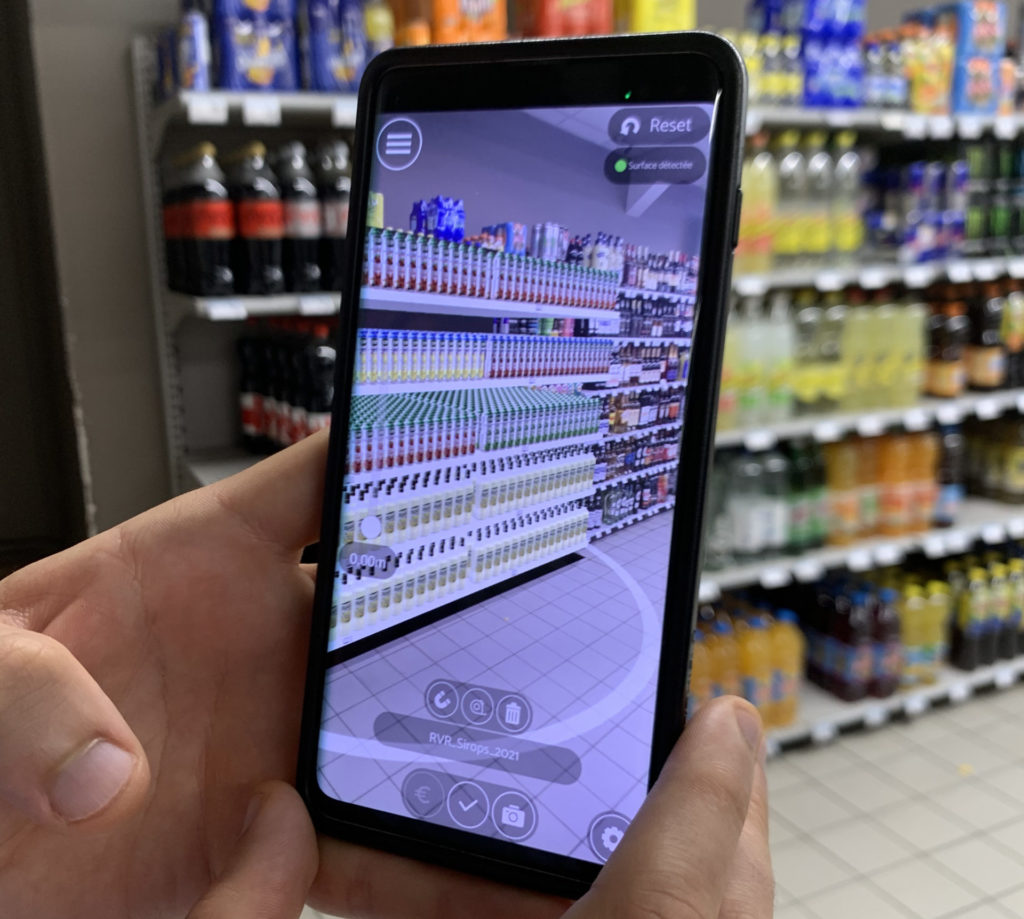
Using just a smartphone, sales reps equipped with the Instore Activation app can project a realistic visualization of concept and layout proposals directly into the stores of both B2C and B2B customers.
Virtual reality for merchandising
The second innovation in merchandising is virtual reality. To understand consumer choices effectively, shopper or consumer studies are essential. Traditionally, these studies are expensive and time-consuming to carry out. They are also geographically limited and can only reach a small number of targets.
The health crisis played a major role in the adoption and spread of virtual reality. It has proven particularly effective and is now used in many fields.
In shopper studies, 3D offers many advantages. It is a true disruptive innovation that makes it possible to:
- Drastically reduce the time needed to set up a study (and therefore its cost).
- Reach a wider target, faster.
- Run several studies at the same time.
- Cover a larger geographic area (national/international).
Consumers are looking for new experiences. According to Esteban Kolsky, "72% of customers will share a positive experience with 6 or more people."
Virtual reality also makes it possible to analyze the in-store shopping journey or test new layouts. Thanks to the 3D digital twin of a store, Retail Staging makes it easier to define your store layout strategy.

The VR showroom for merchandising
The third innovation in merchandising is the Virtual Showroom. A 360° Virtual Showroom delivers a physical experience in a digital setting.
Using a digital twin makes it possible to completely rethink the in-store customer journey and offer a different, immersive experience. It is a further step in improving store layout and merchandising in general. You can create a genuinely immersive shopping experience within a Virtual Showroom. You can guide customers toward the products they like and steer them toward relevant add-on purchases, while still giving them plenty of freedom to act, meeting their need for autonomy. This experience can also serve as a bridge to physical stores. Two figures to remember: 60% of people who have already bought through a virtual store want to do so again; 70% of consumers who visited a virtual store went on to make a purchase.

What's next for innovations in merchandising?
The advent of Web 3.0, and more specifically the metaverse (a persistent virtual space accessed through an avatar), heralds the revolution now transforming retail. Indeed, 60% of young and future consumers believe brands should use the metaverse to sell. Merchandising, and the retail sector more broadly, must now take into account these new opportunities and the consumer behaviors that come with them: NFTs, cryptocurrency, D2A.
9 success factors to implement in merchandising
In 1963, Charles Kepner set out five rules for optimizing merchandising in his book Modern Supermarket Operations:
- The right product
- The right price
- The right place
- The right time
- The right quantity
Today, these principles can be taken even further. In our view, the arrival of new tools, as we saw earlier in this article, brings additional rules to maximize merchandising:
- The right information: an XXL product sheet with photos, videos and QR codes.
- The right presentation: a fully customizable and modular 3D environment.
- The right atmosphere: conveying the brand image to customers.
- The right availability: online sales connected to your Shopify inventory.
Bringing innovation into the shopping experience goes beyond Charles Kepner's principles and kicks off a merchandising revolution, and more broadly a retail revolution.
Don't miss the boat: virtual commerce (v-commerce) is the future of retail! Discover our 3D Merchandising solutions.


.webp)
.webp)
.webp)

