

.png)
The wide gap between strategy and reality on the ground
In many retail and FMCG organizations, the situation is the same: ambitious trade marketing strategies and carefully constructed planograms, but inconsistent and uneven execution in stores. Between the vision at headquarters and the reality at the point of sale, the chain is fragmented. The result: loss of impact, dilution of the brand message, and difficulty in measuring actual performance.
Faced with these challenges, one question becomes central: how can strategy, planograms, and store execution be effectively connected? This is precisely where next-generation 3D merchandising tools such as Retail VR are changing the game.
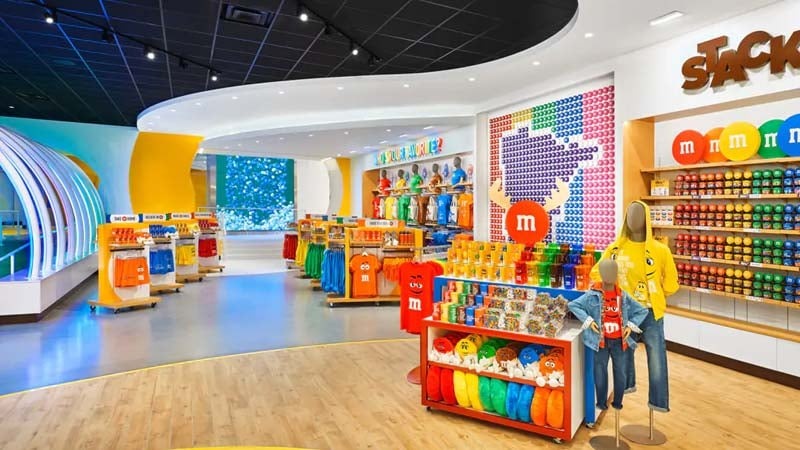
1. Trade marketing, planograms, store execution: three silos that are still too separate
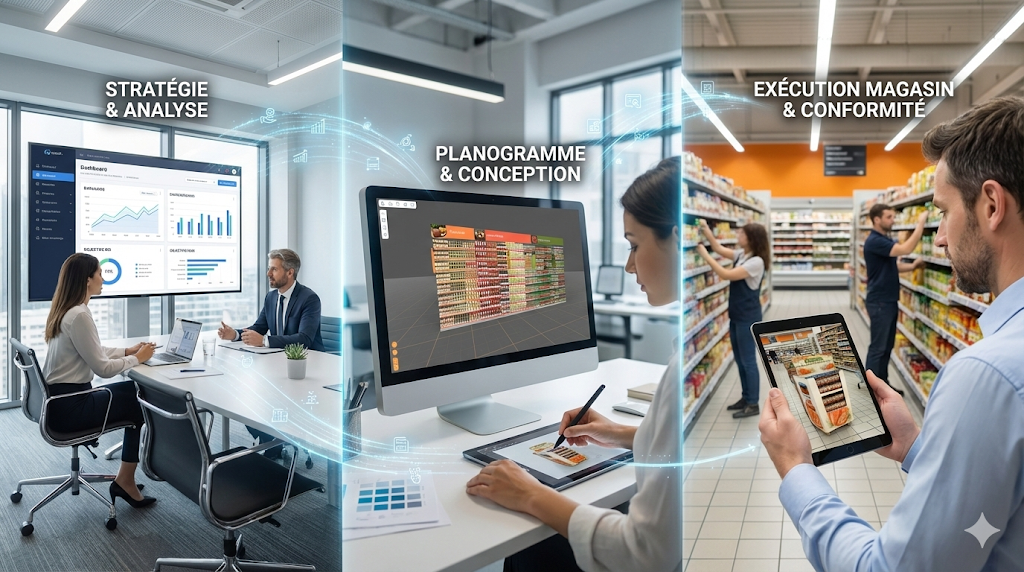
To understand the problem, we need to analyze the three links in the merchandising chain that still struggle to communicate:
- Trade marketing: this aims to activate the brand in-store (theatrical displays, promotions, cross-merchandising). However, these intentions often remain stuck in PowerPoint presentations, PDF guidelines, or 2D visuals that lack realistic projection.
- The planogram: it structures the space (facings, assortment, shelf space). While essential to performance, the traditional planogram is technical, dry, and rarely thought of as a storytelling tool for Category Management.
- Store execution (the weak link): At the end of the chain, field teams (area managers, department managers) must interpret complex guidelines in the face of significant local constraints. Without a clear visual projection, implementation becomes approximate.
2. Why the strategy → plans → store connection has become critical
Today, several trends make this connection essential:
- Acceleration of trade marketing cycles (more operations, less time)
- Increase in store formats
- Need measurable ROI on every activation
- Requirement for brand consistency, including internationally
Brands and retailers no longer have the luxury of working in silos. They need a single tool that can bridge the gap between strategic thinking, merchandising design, and field deployment.
3. The key role of virtual merchandising plan in this transformation
The 3D planogram marks a break with traditional approaches.
From technical constraint to projection tool
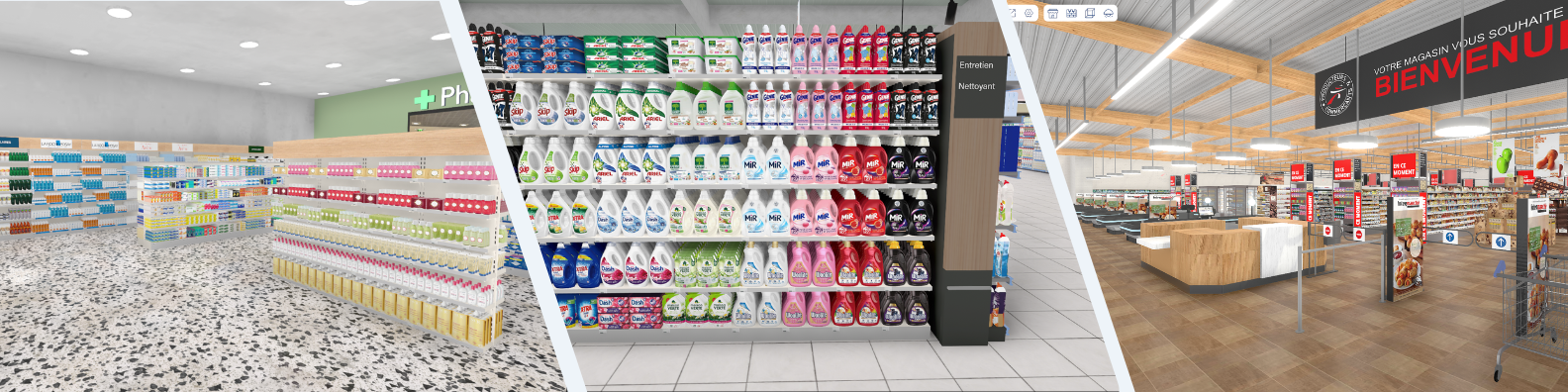
Unlike 2D planograms, 3D planograms allow you to:
- view the shelf layout as in the store,
- integrate POS advertising, furniture, ILV, gondola ends,
- instantly understand the trade marketing intent.
It becomes a common language between marketing, category management, sales, and the field.
A decision-making tool, not just an execution tool
Thanks to 3D, teams can:
- test several implementation scenarios,
- balance commercial performance and visual impact,
- validate more quickly internally and with partners.
4. Retail VR: connecting the entire chain, from strategy to execution
Retail VR is precisely in line with this logic of continuity.
A tool designed for marketing, merchandising, and field teams
Our collaborative platform makes it possible to create immersive in-store environmentsthat can be used directly by:
- trade marketing teams (activation, storytelling, POS advertising),
- category managers (planograms, assortment, facings),
- sales teams and stores (clear projection, actionable instructions).
From strategic brief to simulated shelf layout
In concrete terms, Retail VR allows you to:
- translate a trade marketing strategy into 3D scenarios,
- integrate planograms into a realistic store environment,
- simulate the impact before any deployment,
- produce clear materials for field implementation.
5. Improve store execution through immersive visualization
Less interpretation, more compliance
An interactive 3D visual is much more explicit than a PDF document. Store teams understand:
- where to place each product, particularly thanks to the ability to virtually lay out all your products in advance,
- how to install the POS display,
- what final result is expected.
Result:
- fewer errors,
- fewer field returns,
- better compliance with guidelines.
Operational time savings
3D drastically reduces:
- traveling back and forth between headquarters and the field,
- post-deployment corrections,
- the use of external agencies for each adaptation.
6. Manage store performance more intelligently
Connecting strategy, planogram, and execution also allows for better measure performance.
With a tool like Retail VR, it becomes possible to:
- compare several locations before deployment,
- standardize best practices,
- analyze the gaps between concept and reality in the field,
- capitalize on the most effective activations.
Merchandising is no longer just about aesthetics: it has become a real driver of business management.
7. A key advantage for multi-brand and international deployments
For brands present in multiple stores or countries, the challenge is twofold:
- ensure overall consistency,
- while allowing for local flexibility.
3D makes it easy to adapt:
- the same trade marketing concept in different store formats,
- a planogram with local constraints,
- activation at multiple levels of merchandising maturity.
Conclusion: from fragmented merchandising to a finally seamless chain
Connecting trade marketing, planograms, and store execution is no longer optional. It is a prerequisite for sustainable performance in an increasingly complex and competitive retail environment.
By reconciling strategic vision, merchandising design, and reality on the ground, 3D merchandising solutions such as Retail VR enable:
- a better collective understanding,
- more faithful execution,
- a more measurable ROI,
- and an overall increase in the teams' skills.
From strategy to shelf space, merchandising is finally becoming a continuous, visual, and collaborative process, rather than a series of silos.


.webp)
.webp)
.webp)

